The 30-Minutes-a-Day Job Search That Actually Works
You don't need a free weekend or a burst of heroic motivation. You need a small, repeatable block of time — and a way to make those minutes actually count.

It's 9pm. You promised yourself you'd "do some job searching tonight." So you open a board, scroll, open a few tabs, read half a job description, get distracted, and an hour later you've applied to nothing. Sound familiar? The problem usually isn't laziness or lack of time — it's that an open-ended "job search" has no edges, so it expands to fill the whole evening and still produces almost nothing.
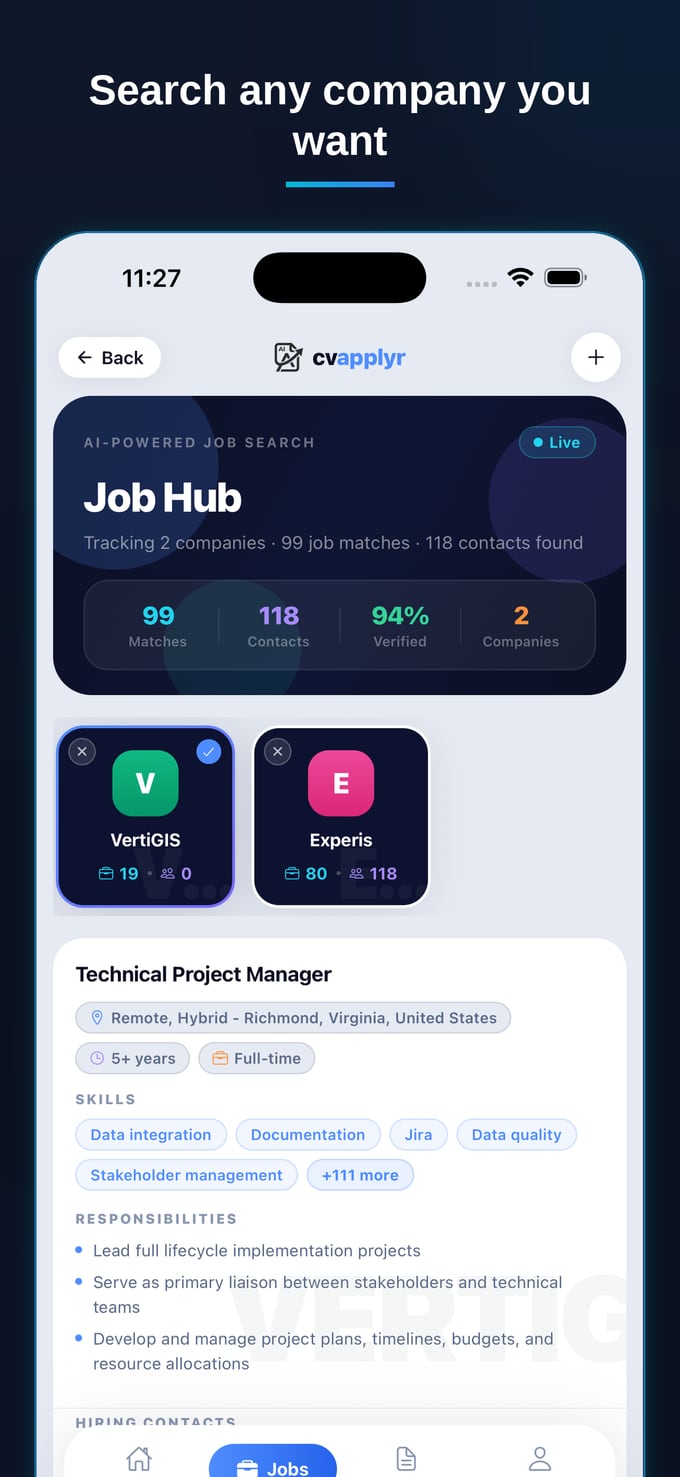
The fix is counterintuitive: do less time, but make it structured. A tight, 30-minute daily block beats a vague two-hour slog because it has a clear start, a clear finish, and a clear job to do. The catch is that 30 minutes only works if you're not spending most of it on the slow, repetitive stuff. That's exactly what this routine — and the tool behind it — is built to remove.
Why "just spend more time" backfires
Most advice tells you to treat the job hunt like a full-time job: hours a day, every day. For a few people that works. For everyone else it leads to one exhausting Sunday marathon, a wall of dread, and then days of avoidance. Long sessions feel productive but they're where burnout lives — and burnout is what actually ends most job searches early.
There's a sharper reason daily-and-short wins, too. Roles get the most attention right after they're posted, and applications that go in early tend to get seen. A weekly marathon means you're always a few days late. A daily 30-minute pass means you catch fresh postings while they're still warm — and you keep a steady drumbeat going instead of stop-start sprints.
And there's the emotional math, which most guides ignore entirely. A job search is a slow, rejection-heavy process, and the people who finish it aren't the ones who start hardest — they're the ones who don't quit. A four-hour session you dread is easy to skip; a 30-minute block you can do half-asleep is hard to skip. Lowering the daily cost is the single most reliable way to keep the search alive long enough to actually land something.
The 30-minute routine, minute by minute
Here's the whole thing. Four moves, one short block, every day. The point isn't to rush — it's that each step is small precisely because the heavy lifting happens in the background.
1. Review your matches — 8 minutes
You don't open with searching, because searching is the time-sink that derails every evening. Instead you open to a short list of roles already matched to your resume and scored by fit. You skim, you triage: a quick yes, a maybe, a no. By minute eight you have three or four roles worth applying to — without ever opening twenty tabs or reading a single irrelevant listing.
2. Send tailored applications — 14 minutes
This is your biggest block, and rightly so — it's the part that actually moves the needle. For each role you accept, there's already a cover letter written for that job, drawn from the description and your resume. You read it, tweak a line if you want it sharper, and send. Done by hand, tailoring one letter eats 15 minutes. Here, that's the time it takes for the whole batch. Three or four real, tailored applications in a single sitting.
3. Reach one real contact — 5 minutes
Every day, pick one role and go a step further than the application form: reach an actual person. CVApplyr helps surface a recruiter or hiring-manager contact, so instead of dropping your application into a black hole you send a short, direct note. One a day adds up to a real network of warm threads by the end of the month — and direct outreach is how you stop wondering whether anyone saw your application at all.
4. Log it and follow up — 3 minutes
The fastest way to waste your first three steps is to forget them. So you close the loop: every role you acted on is saved with its status, contact, and notes. Spend the last few minutes checking what needs a nudge — anything you sent four or five days ago and haven't heard back on gets a one-line follow-up. Then you close the laptop, on time, with real output behind you.
Why 30 minutes is enough now (and wasn't before)
If you tried this routine with nothing but a browser and a spreadsheet, it would fall apart by Tuesday. Reviewing matches would mean searching. "Send tailored applications" would mean writing each letter from scratch. "Reach a contact" would mean an hour of LinkedIn detective work. The math simply doesn't fit in half an hour — which is why most people give up on a daily routine and slide back into the dreaded marathon.
What makes a 30-minute day realistic is that the slow parts are compressed. CVApplyr does the searching (matched roles come to you), the writing (a tailored cover letter per role, in seconds), the digging (surfacing a real contact), and the bookkeeping (everything tracked in one place). Strip those out and what's left is the part that genuinely needs you: judgment, a quick edit, a send. That's a 30-minute job, not a four-hour one.
A job search dies in the gap between "I should apply" and "I actually applied." Shrink that gap to a 30-minute habit and the search keeps running long after motivation runs out.
Making the habit stick
The routine only works if it actually happens, so anchor it. Attach the block to something you already do every day — right after your morning coffee, or the moment you sit down after dinner. Same time, same trigger. Because the steps are small and the tool removes the friction, there's nothing to dread, which is exactly why the habit survives the weeks when your willpower doesn't.
Some days you'll have only 15 minutes — do steps one and two and call it a win. Some days you'll be in flow and run long — great, bank a few extra applications. The number on the clock matters less than the streak. Show up, send a few good applications to real people, log them, and let the compounding do the rest.
It also helps to define what "done" looks like before you start, so the block actually ends. "Send three tailored applications and reach one contact" is a finish line; "do some job searching" never is. When you hit the target, you stop — guilt-free — even if there are more roles in the list. They'll still be there tomorrow, and so will you. That permission to close the laptop is what keeps the habit from quietly mutating back into the open-ended evening that wore you down in the first place.
Run this for a month and the numbers stack up quietly in your favour: roughly twenty tailored applications a week, twenty-odd direct contacts, and a tracked pipeline you can actually follow up on — all from a block of time shorter than an episode of TV. Not because you found extra hours, but because you stopped spending the ones you had on work a tool can do for you.
Make your 30 minutes count
Matched roles, tailored cover letters, real contacts, and tracking — all in one place. Free to start.
Download CVApplyrFrequently asked questions
Can you really job search in 30 minutes a day?
Yes — if those 30 minutes are focused and the slow parts are removed. The reason a job search swallows whole evenings is the repeated work: rewriting cover letters, hunting for contacts, retyping the same details. Automate those, and 30 minutes is enough to review your matches, send a few tailored applications, reach one real person, and log it all.
What should a daily job-search routine include?
A good daily routine has four parts: review fresh matched roles, send a small batch of tailored applications, reach out to one real contact, and log everything so you can follow up. Doing all four every day beats doing one of them in a marathon session once a week.
Is it better to job search every day or in long batches?
Daily, in short blocks, almost always wins. Long batches burn you out, miss freshly posted roles, and let follow-ups slip. A consistent 30-minute block keeps you applying while postings are new and keeps momentum without the dread of a four-hour marathon.
How does CVApplyr make a 30-minute routine possible?
CVApplyr compresses the slow parts. It surfaces resume-matched roles so you skip the searching, writes a tailored cover letter for each one in seconds, helps surface a recruiter or hiring-manager contact, and tracks every application in one place. What's left for you is judgment and a few taps — which fits comfortably in half an hour.