How Many Jobs Should You Actually Apply To? (The Real Numbers)
Everyone has an opinion — "quality over quantity," "it's a numbers game." The honest answer is both, and the math behind it is less scary than it sounds once you see it laid out.

You've heard both pieces of advice, probably in the same week. One person swears you should pour your soul into five perfect applications. The next tells you it's a numbers game and you should be firing off fifty. So which is it? The frustrating truth is that they're both partly right and both incomplete — and the only way to settle it is to look at what actually happens to an application after you hit submit.
So let's do that. We'll walk through the real conversion math of a job search, figure out what a sensible weekly number actually is, and — most importantly — show why the "quality vs. quantity" debate is a false choice that quietly wastes a lot of good candidates' time.
The funnel nobody shows you
Here's the uncomfortable part most advice skips: a single application is not a coin flip. It's the top of a funnel that narrows hard at every stage. The average corporate opening attracts a crowd, a handful get interviewed, and exactly one person walks away with the offer.
Read that funnel backwards and the strategy writes itself. If only a small fraction of applicants get an interview, and only one of those gets an offer, then any single application has long odds no matter how good you are. That's not a knock on you — it's just arithmetic. To get a few interviews, you need to be in a few dozen funnels. To get a few offers, you need to be in a lot of them.
This is the half the "numbers game" crowd gets right. Volume genuinely matters, because the per-application conversion rate is low and largely outside your control.
So… what's a sane weekly number?
Let's turn the funnel into a plan. Suppose your applications convert to interviews at a modest rate, and interviews convert to offers at a normal rate. Working backwards from "I'd like an offer or two in a couple of months," most people land on a target of roughly 10–20 well-matched applications a week. Over a typical search that's somewhere between 100 and 200 applications total — which lines up with what a lot of successful job seekers report.
But notice the load-bearing word in that target: well-matched. Ten applications to roles you actually fit, each tailored, will beat fifty scattershot ones every time. The recruiter spends about six seconds on the first pass — if your application doesn't visibly match the role in those six seconds, the volume didn't buy you anything. That's the half the "quality over quantity" crowd gets right.
Why "quality vs. quantity" is a trap
Here's why that debate persists: doing both at once is genuinely hard by hand. A tailored application — reading the job description, matching it to your background, rewriting the cover letter, finding the right person — takes most people the better part of an hour. So you're forced to choose: either send a lot of generic applications, or send a few great ones slowly. Both options leave you with a weaker pipeline than you deserve.
The trap is treating that trade-off as a law of nature. It isn't. It's a tooling problem. The reason you can't do quality at quantity is that the repetitive, tailoring-heavy parts of every application are done from scratch each time. Remove that, and the whole "quality vs. quantity" dilemma dissolves.
Picture two job seekers over the same month. The first plays "quality" and sends five hand-crafted applications a week — twenty in total, each lovely, but a tiny top of funnel. The second plays "quantity" and blasts fifty generic ones a week, most of which a recruiter dismisses in those six seconds. Both are working hard; both are leaving results on the table. The candidate who actually wins is the third one you rarely hear about — the one sending twenty tailored applications a week, because they've made tailoring cheap. Same effort as the "quality" purist, four times the pipeline, and none of the generic-application penalty.
Volume and relevance only compete when tailoring is manual. Automate the tailoring, and you stop choosing between hitting your number and respecting it.
How to hit the number without hating your life
This is exactly the gap CVApplyr is built to close. The Job Hub takes the two things that normally fight each other — high volume and high relevance — and lets you have both at once. Here's how that plays out in practice.
1. The matches come pre-filtered for relevance
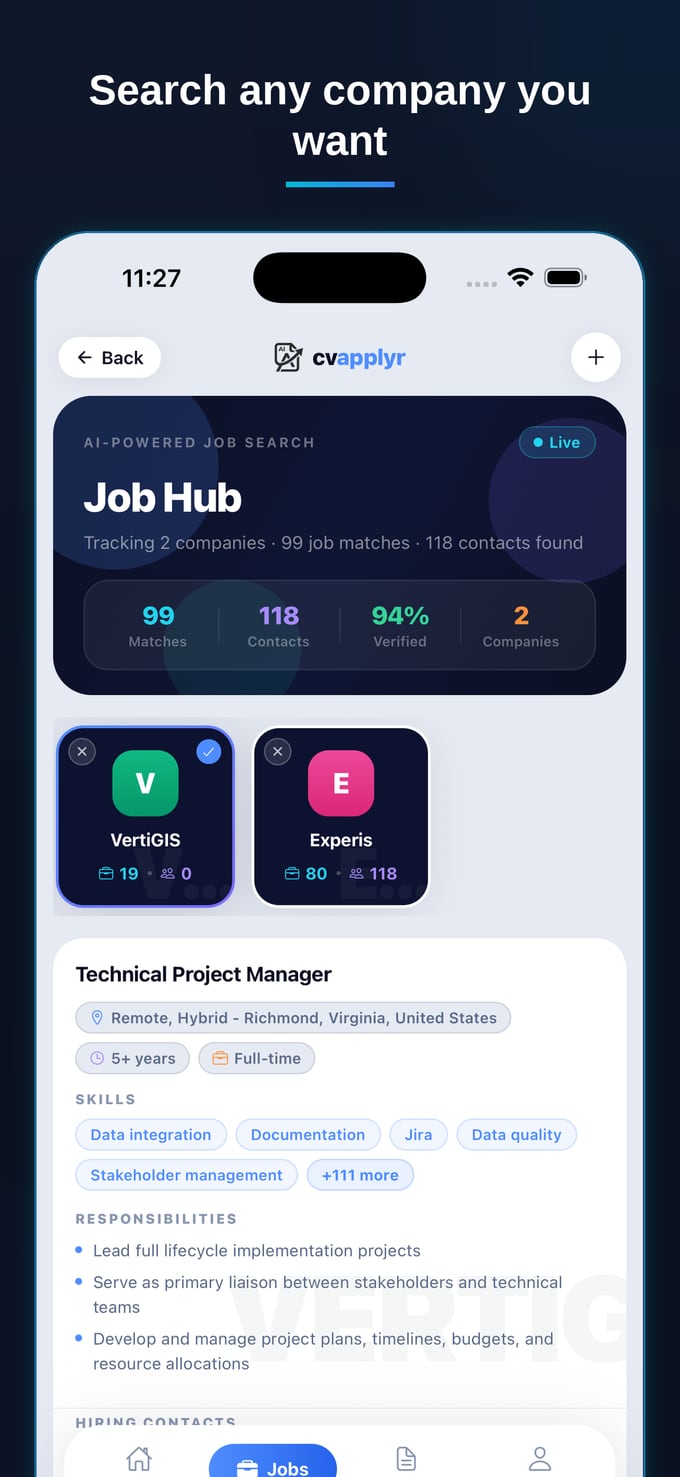
Instead of you scrolling boards and guessing, the Job Hub surfaces real openings from company careers pages, scored by how well they fit your resume. So your "10–20 a week" starts as 10–20 roles you actually have a shot at — the volume is already relevant before you lift a finger. You're not padding your number with long shots; you're filling it with fits.
2. Each application gets tailored automatically
This is the part that used to force the quality-vs-quantity choice. CVApplyr reads each job description against your background and writes a cover letter tuned to that specific role. The hour-long tailoring step becomes a quick review. That's the whole trick: when tailoring is nearly free, sending more applications doesn't dilute their quality.
3. Where possible, you reach a real person
Being one of 250 applicants is a lot better when you're not anonymous. For many roles CVApplyr surfaces a recruiter or hiring-manager contact, so you can apply directly to a human instead of into an applicant-tracking black hole. That nudges your odds inside every funnel you enter — quietly making each of your applications worth more.
4. Every application is tracked, so the number is real
"Apply to 15 a week" only works if you can see where you actually are. Every role you act on is saved with its status and contacts, so your weekly number is a real, visible pipeline you can follow up on — not a vague feeling that you've "been applying a lot."
Put it together and the strategy stops being a willpower test. You glance at a short list of matched roles, accept the tailored letters that look right, send them to real contacts where available, and the whole thing lands in a tracker. The number takes care of itself — and it's a number of good applications, which is the only kind worth counting.
Hit your number — the quality kind
Get resume-matched jobs, a tailored cover letter for each, and real contacts where available. Free to start.
Download CVApplyrFrequently asked questions
How many jobs should I apply to per week?
A practical target for most people is 10–20 well-matched applications a week. That's enough to keep your pipeline full given typical conversion rates, without spreading yourself so thin that every application becomes generic. The key is that they're matched and tailored, not just sent.
Does applying to more jobs actually help?
Yes, up to a point — job hunting is a numbers game because interview and offer rates per application are low, so a bigger top of funnel means more interviews. But volume only helps when each application is still relevant and tailored. A hundred copy-paste applications convert worse than twenty targeted ones.
Is it better to apply to fewer jobs with better applications?
It's not either/or. The best outcomes come from high volume and high relevance at the same time: apply to many roles you genuinely fit, and tailor each one. The reason people pick "fewer but better" is that tailoring by hand is slow — automate the tailoring and you get both.
How does CVApplyr help me apply to more without burning out?
CVApplyr's Job Hub surfaces roles matched to your resume, writes a tailored cover letter for each one, and surfaces a recruiter or hiring-manager contact where available — then tracks every application. So you hit a high weekly number while each application stays high quality, without doing the repetitive work by hand.