Job Searching After a Layoff: A Calm, Fast Playbook
A layoff scrambles two things at once — your income and your confidence. The cure for both is a plan small enough to start today and steady enough to keep going.

The email lands, or the meeting ends, and suddenly the calendar that organised your whole week is gone. There's the practical panic — rent, benefits, the runway you can count in months — and underneath it a quieter, sharper thing: the sense that you have to fix all of this right now, and you have no idea where to start. So you open a job board, stare at it, close it, and the day disappears. That paralysis isn't weakness. It's what happens when a huge, formless task meets a brain that's still processing a shock.
Here's the reframe that changes everything: you don't have to solve "find a new job" today. You have to do one small, defined thing today, then a slightly bigger one tomorrow. A layoff search goes wrong when it stays a vague cloud of dread. It goes right when it becomes a short, repeatable routine — a pipeline you feed a little each day. This playbook lays that pipeline out, and shows where the right tools quietly carry the repetitive weight so your limited energy goes to the parts only you can do.
Why a post-layoff search feels uniquely hard
Every job search is work. A post-layoff search adds three things on top that nothing prepares you for.
The first is emotional load. You're being asked to sell yourself convincingly at the exact moment your confidence is lowest. Writing a fresh, upbeat cover letter feels almost dishonest when you're still stinging.
The second is volume pressure. With a runway ticking down, the instinct is to apply to everything, immediately — which leads to a frantic day or two of generic applications, then collapse. That sprint-then-crash cycle is the most common way layoff searches stall.
The third is decision fatigue. Which roles? Which version of my resume? Did I already apply here? Each tiny choice burns fuel you don't have. By the time you've decided what to do, you're too drained to do it.
A two-week restart, mapped
You don't need a 90-day grind. You need a gentle on-ramp: one week to reset the foundation, then a second week where applying becomes a short, almost boring daily habit. Here's the shape of it.
Week one: rebuild the foundation
Week one has exactly three jobs. None of them is "apply to 50 things." Resist that. You're laying track so week two can roll.
1. Refresh your resume — without staring at a blank page
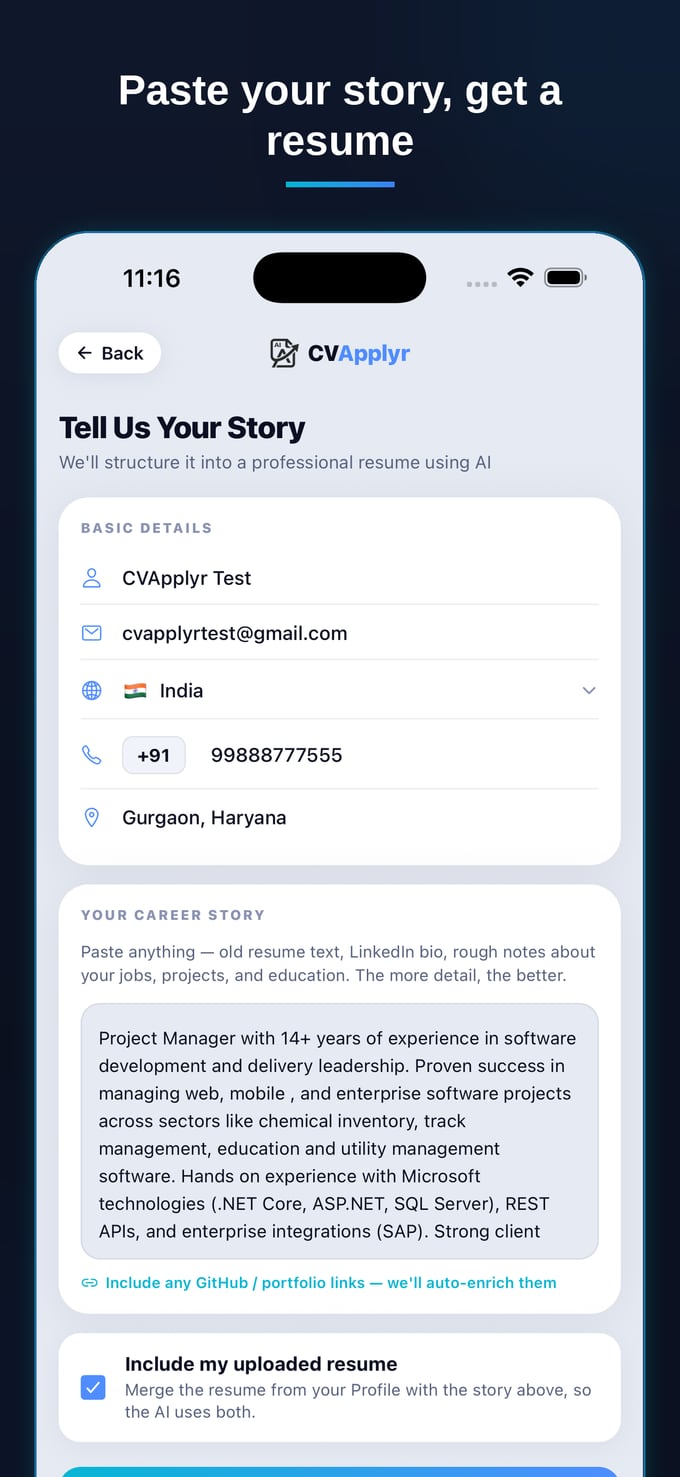
Your old resume probably ends at the job you just left, and updating it is precisely the kind of task that's easy to avoid when you're low. The trick is to not start from the document at all — start from your story. Talk through what you did, what you shipped, what you're proud of, and let that become the resume. CVApplyr's "Tell Us Your Story" flow does exactly this: you describe your experience in plain language and it builds a clean, country-correct resume you can refine, instead of you wrestling formatting at your lowest-energy moment.
2. Choose two or three targets — not "anything"
"I'll apply to anything" feels productive but quietly doubles your work, because every different kind of role needs a different angle. Pick two or three role types you'd genuinely take, plus where you'll work (a city, remote, or both). Narrowing isn't giving up — it's the thing that lets everything downstream run on rails.
3. Set a time box and protect it
Decide on a fixed block — 45 to 60 minutes a day is plenty — and decide when it happens. When the block ends, you stop, even if you "could do more." The boundary is what makes this survivable for weeks instead of imploding in three days. Open-ended searching is what burns people out; a finite, repeatable routine is what doesn't.
Week two: apply at a steady pace
This is where most layoff advice waves its hands — "just keep applying!" — without acknowledging that applying is the part that drains you. So week two is built around removing the repetition, not adding more grit.
Let matched roles come to you
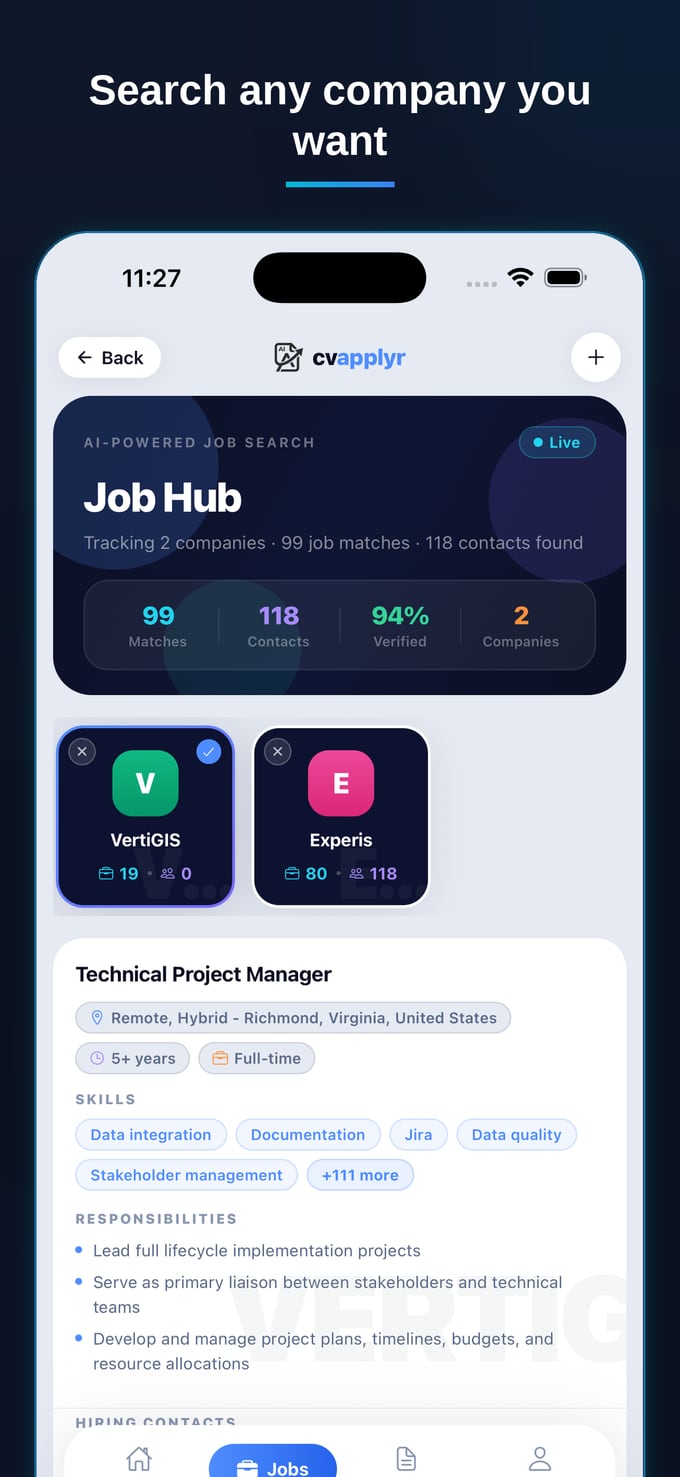
Instead of re-opening job boards and re-making the same decisions, you let CVApplyr surface openings from real company careers pages that fit your refreshed resume, scored by how well you match. Your daily block starts with a short, relevant list — not an ocean of tabs and the question "is this even worth my time?" That single change removes most of the decision fatigue.
Send a tailored letter — to a real person
The most emotionally taxing task, writing a fresh cover letter for every role, is the one AI is genuinely good at. CVApplyr reads the job and your resume and drafts a letter tuned to that role, in your voice; you skim, adjust a line, send. And rather than firing it into an applicant-tracking black hole, it helps surface a recruiter or hiring-manager contact so your application reaches an actual inbox — which matters even more when you're trying to climb out of a gap.
A layoff feels like losing control. The fastest way to get it back isn't a perfect ten-hour day — it's a small, finite routine you can repeat tomorrow, and the day after, without it crushing you.
Track everything, so follow-up is a tap
When you're applying daily, "did I already apply here?" and "should I follow up on that one?" become real questions that eat time and confidence. Every role you act on in CVApplyr is saved with its status, contacts, and notes, so your pipeline is always visible at a glance and following up is one tap — not an excavation of your sent folder. That visibility is also weirdly reassuring: on a hard day, you can see the pipeline you've built, even when no single reply has landed yet.
What a calm restart actually looks like
Put it together and the overwhelming cloud becomes a routine you can almost do on autopilot. You sit down for your block, review a short list of matched roles, accept the tailored letters that read right, send them to real contacts, log them, and close the laptop — pipeline intact, follow-ups queued, the rest of your day still yours to recover in. You're not white-knuckling through 50 generic applications and burning out by Thursday. You're feeding a steady machine, and steady is what wins a layoff search.
Turn the restart into a steady pipeline
Refresh your resume, get matched roles, send tailored letters to real contacts, and track it all — free to start.
Download CVApplyrFrequently asked questions
How soon should I start applying after a layoff?
Give yourself a few days to absorb the shock and sort out the practical paperwork — final pay, benefits, any severance. But don't wait for the grief to be fully gone before you start; momentum is its own kind of relief. A light first week of resetting your resume and choosing targets, followed by steady daily applying, beats trying to do everything the moment you're upset.
Should I mention the layoff in applications?
You don't need to over-explain. Layoffs are common and rarely a reflection of your performance — a brief, neutral line such as "my role was eliminated in a company-wide reduction" is plenty if it comes up. Focus your cover letter and resume on what you can do for the new employer, not on defending the gap.
How do I avoid burnout while job searching after a layoff?
Set a fixed, finite block of time each day and stop when it's done. The exhaustion comes from open-ended, repetitive effort — rewriting cover letters, hunting for contacts, re-tracking everything. Automating those repeatable parts so you only make the human decisions keeps a daily pace sustainable for weeks, not days.
How does CVApplyr help after a layoff?
CVApplyr turns the overwhelming restart into a steady, matched, tracked pipeline: it surfaces roles that fit your resume, writes a tailored cover letter for each, helps you reach a real recruiter or hiring-manager contact, and saves every application with its status so follow-ups are a tap. It's free to start.