Should You Apply If You Don't Meet All the Requirements?
You read the posting twice, counted seven matches out of ten, and closed the tab. That reflex costs more good roles than any rejection ever will.

The role is genuinely exciting. The team sounds right, the salary works, and you could picture the first ninety days. Then you get to the requirements: eight bullets, and you're a clean yes on five, a stretch on two, and a definite no on one. So you do what almost everyone does — decide you'd be wasting their time, and go back to the list.
The trouble is that the bullet you failed on was written by someone who was describing a person who does not exist.
This article is about how to make that call properly: what a job description actually is, which requirements are real gates and which are decoration, and why the honest answer to "should I apply?" depends less on your CV than on what applying costs you.
A job description is a wishlist, not an entry exam
Here is how most postings get written. A manager needs a person. They open the last version of a similar posting — possibly written for a different team, two years ago, by someone who has since left. They add the things that went wrong with the last hire. A stakeholder adds the tool their side of the business uses; HR adds a degree line because the template has one. Nobody removes anything, because removing a line means defending its absence in a meeting.
What comes out the other end is not a specification. It's an accumulated wishlist describing an ideal candidate the company would love to find and does not expect to. Hiring managers know this. They routinely hire people who missed several bullets, because the alternative — leaving the role open for another quarter — is worse than a candidate who has to learn a tool.
The commonly cited version of this is the internal report claiming men apply when they meet about 60% of the criteria while women wait until they meet nearly all of them. The figure gets repeated more confidently than the evidence supports, but the follow-up work is the interesting part: when researchers asked people why they didn't apply, the most common answer wasn't a lack of confidence in their ability. It was a belief that the requirements were hard rules and applying anyway would be a waste of everyone's time.
That belief is the actual problem, and it's a misreading of the document. You're treating a negotiating position as a legal threshold.
Sort the bullets into three piles
The useful skill isn't optimism — it's triage. Read the requirements once and put every line into one of three piles.
Gates are the ones that genuinely end the conversation, and there are far fewer than you think. Legal eligibility to work without sponsorship the employer won't provide. A licence or certification the law requires — you cannot talk your way into practising medicine. Security clearance. A physical location or shift pattern you can't meet. If you fail a gate, move on with a clear conscience; nothing in your cover letter fixes it.
Core is what the job actually is. For a backend role, that's building and running services, not the specific message queue. For a finance role, it's owning a close process, not the ERP vendor. Ask yourself what the person would be doing in month one — if you can do that thing, you're in the conversation, even if you'd be doing it in an unfamiliar tool.
Wishlist is everything else, and it's most of the list. "5+ years" is a proxy for judgement, and proxies are negotiable. A named tool is a proxy for the category of tool. "Experience in our industry" is a proxy for not needing six months of context. Each of these can be answered with adjacent evidence — and if you don't offer that evidence, nobody will invent it for you.
The real question is what applying costs you
Here's the part of this decision nobody frames properly. "Should I apply at 70%?" is not really a question about your qualifications. It's an expected-value question, and the cost side dominates it.
Applying properly by hand takes most of an hour: rereading the description, reworking your resume's wording, writing a letter that isn't generic, finding the right person, and fighting a portal form that asks you to retype the resume you just uploaded. At that price, being choosy is rational. If each application costs forty minutes, you can only afford a handful a week, so you save them for the roles you're near-certain about — and near-certain means 90%+, which is exactly the trap.
Now change the price. If an application costs five minutes, the arithmetic inverts. A 60% match with a 5% chance is suddenly worth sending, because the cost of being wrong is five minutes and the cost of being right is a job. The threshold at which "apply anyway" makes sense is not a fact about you. It's a function of your per-application cost.
This also dissolves the objection people raise against applying widely. "Isn't that just spam?" It would be, if volume came at the cost of relevance. But the thing that made each application expensive was never the judgement — it was the retyping, the rewriting, and the hunting. Automate that and you keep the judgement while losing the drudgery.
How to apply when you're missing something
Deciding to apply is half of it. The other half is not handing the screener a reason to say no.
Never apologise in writing. The single most common mistake is a cover letter that opens by conceding the gap — "although I don't have direct experience with X…". You've just told a person skimming for six seconds exactly which box to fail you on. Lead with the core you do have; address the gap once, late, and framed as a transfer rather than a deficit.
Translate, don't inflate. If they want a tool you haven't used and you've used its direct equivalent for four years, say that plainly: same job, different badge. That's not spin — it's information the screener needs and can't infer. Claiming things you haven't done is a different matter, and it collapses in the first technical conversation.
Mirror their vocabulary for things you have actually done. Most mid- and large-size employers screen with an applicant tracking system, and those systems respond to language rather than intent. If the posting says "stakeholder management" and your resume says "worked with the business", you can be filtered as unqualified for a skill you demonstrably have. Tailoring the wording to each posting is dull, mechanical work that measurably lifts callback rates — which makes it the perfect thing to hand to software.
Get in front of a human where you can. A filter can only compare you to a list. A person can weigh "missed two bullets but has run exactly this problem at a smaller scale" — and that judgement is the entire reason imperfect candidates get hired. A short, specific note to a named recruiter or hiring manager, sent alongside the formal application, is the difference between being scored and being considered.
Apply early. As a queue fills, the bar for a second look rises. The same 70% match reads very differently as the fourth application than as the two-hundredth, which is an argument for seeing roles when they're posted rather than when they're syndicated to the big boards.
You are not being marked out of ten. You're being compared to whoever else applied — and the person who does have all ten bullets very often didn't apply either.
Stop rejecting yourself first
See how you actually match each live role, get a tailored cover letter in seconds, and reach a real contact where we can find one. Free to start.
Download CVApplyrHow CVApplyr changes the calculation
CVApplyr is built around exactly this decision, from both ends: making the judgement better, and making the cost small enough that the judgement stops being agonising.
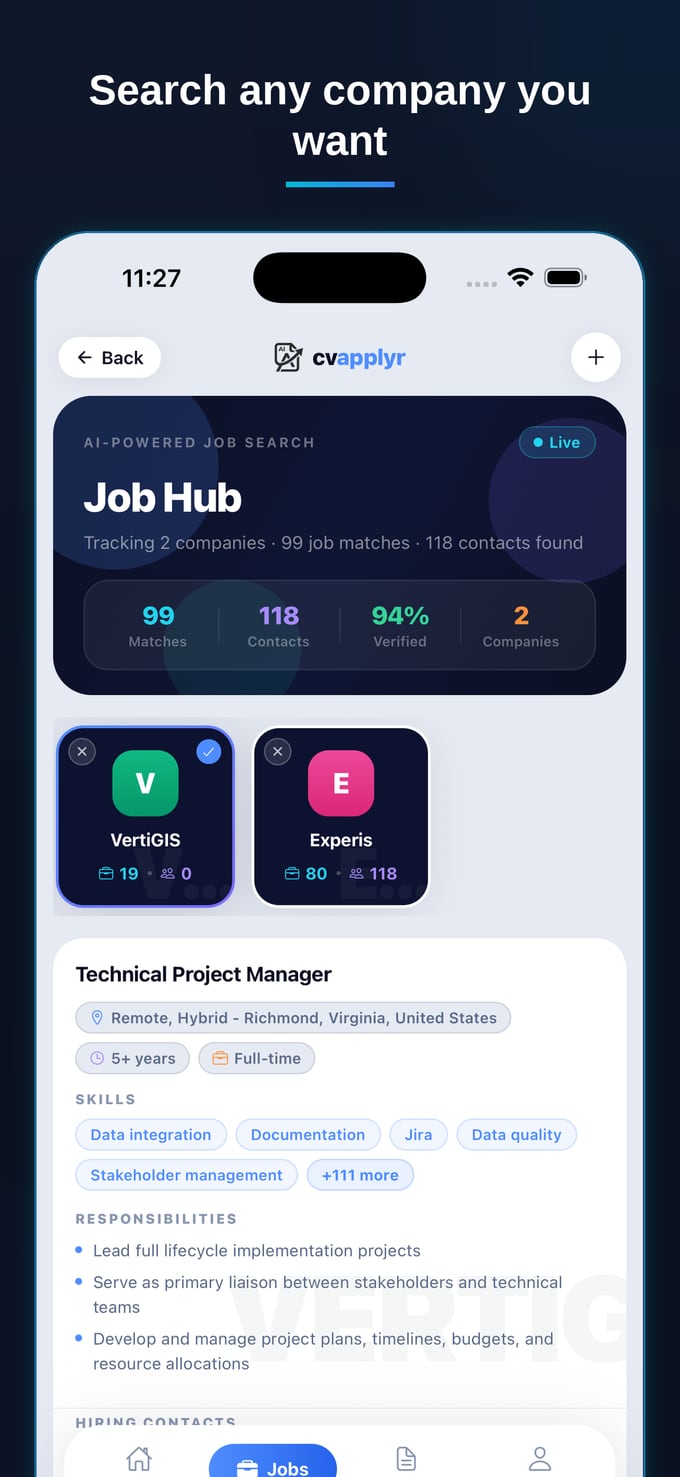
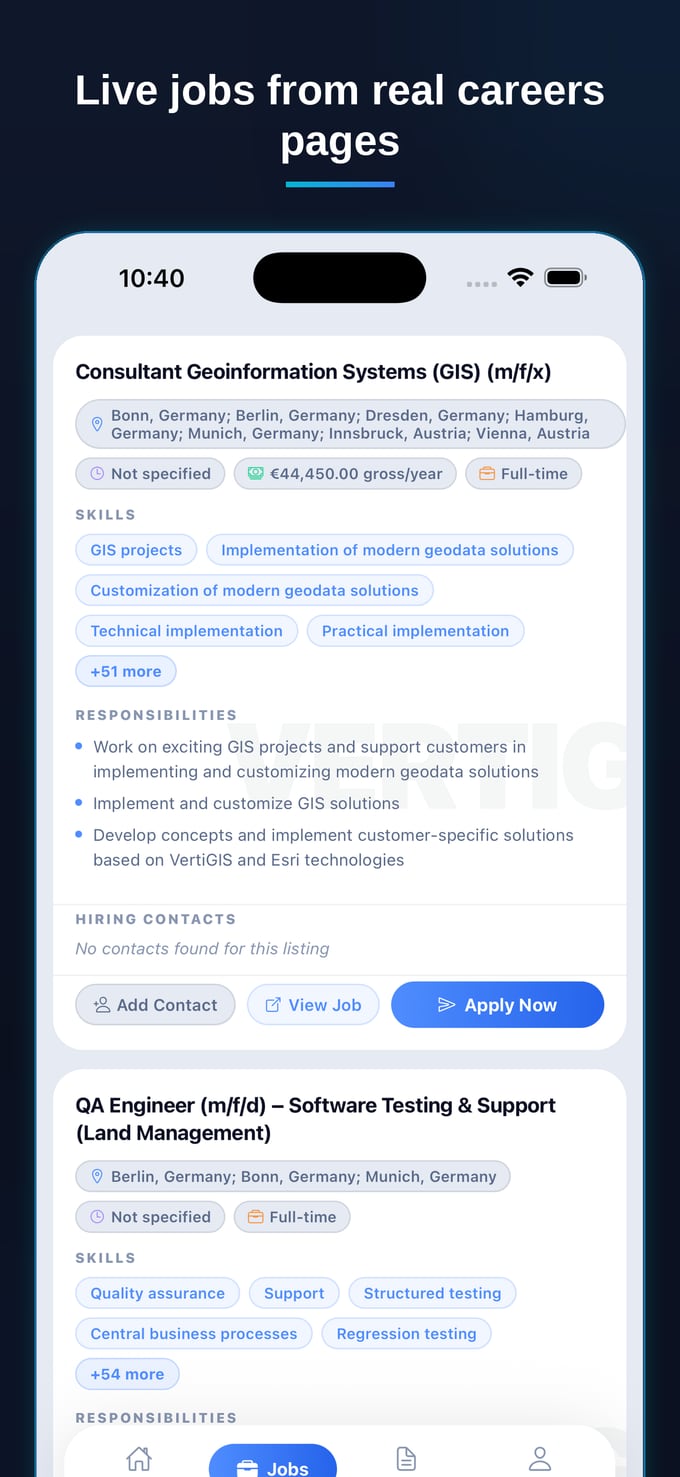
It pulls live openings directly from company career pages and applicant-tracking systems rather than only the big boards, and scores each one against your actual resume. That score is the honest version of the thing you were doing in your head — and it consistently surfaces roles people would have skipped, because the gut estimate is almost always more pessimistic than the evidence.
For any role you choose, it writes a cover letter against that specific job description: your real experience, mapped onto their language, with adjacent skills stated as the transfers they are instead of left for the reader to guess at. It builds your resume in the format employers in that country expect, so a fixable formatting mismatch never becomes the reason. Where a hiring contact can be found, you get a name and an email plus a drafted note with your documents attached — so at least one copy of your application reaches somebody who can exercise judgement. And everything stays tracked in one place, which is what makes following up in week three actually happen.
The point isn't to apply to everything. It's that when an application costs minutes instead of most of an hour, you get to stop rationing your chances — and the roles you'd have talked yourself out of at 11pm become the ones you send before closing the laptop.
Somewhere in your closed tabs from last month is a role you'd have been good at. The requirements list said ten things. You had seven. So did the person they hired.
Frequently asked questions
Should I apply if I only meet 70% of the requirements?
Usually yes. Postings are wishlists assembled from several people's opinions and older versions of the same document, so the full list describes an ideal candidate who rarely applies. What matters is clearing the hard gates — legal eligibility, required licences, the genuine technical core — and offering adjacent evidence for the rest. Missing several nice-to-haves is normal.
Which requirements are actually non-negotiable?
Three kinds: legal and regulatory (work authorisation, a licence the law requires, clearance), the one or two skills the job is genuinely built on, and location or shift constraints the employer can't flex. Almost everything else — years of experience, specific tool names, a preferred degree, a second language — is a preference written as a rule.
Will an ATS auto-reject me for missing a requirement?
Usually it ranks rather than hard-rejects, except on explicit knockout questions like work authorisation. What it really responds to is language: if your resume describes a skill in different words than the posting uses, you can look unqualified for something you've done for years. Mirroring the posting's own vocabulary — for things you genuinely have done — is the highest-value fix available.
How does CVApplyr help when I'm not a perfect match?
It scores live roles against your resume so you can see where you actually stand, writes a cover letter that maps your experience onto that posting's language, and surfaces a hiring contact where possible so a human weighs the trade-off instead of a filter. It also cuts each application from most of an hour to minutes — which is what makes applying to imperfect matches worth doing at all. Free to start.