How to Apply to Jobs Abroad Without Getting Auto-Rejected
Your experience travels just fine. Your resume often doesn't — and a format that's perfect at home can get you screened out abroad before a human ever sees it.

You found the perfect role in Berlin, or Toronto, or Singapore. You attach the resume that's landed you interviews for years, write a quick note, and hit send. Then… nothing. Not a "no thanks," not even a confirmation that a person looked. It's tempting to blame the distance or the visa question — but more often than not, the application was filtered out for a reason that has nothing to do with whether you can do the job: it simply didn't look like what a recruiter in that country expects to receive.
That's the quietly brutal thing about applying abroad. The bar isn't just "are you qualified?" — it's "does this document fit our conventions?" And those conventions change the moment you cross a border. The good news: every one of these traps is fixable, and once you know what they are, getting past them is mechanical. Let's walk through why international applications get auto-rejected — and how to make yours read like a local one.
Why "good enough at home" gets binned abroad
Picture two recruiters opening the same resume. To the one in your home country it looks normal. To the one abroad it looks… off. Too long. Missing a detail they always expect. A photo where there shouldn't be one — or no photo where there should. None of that is about your skills. But it's enough to nudge your application from the "yes" pile to the "next."
And it isn't only humans. Most mid-to-large employers run applications through an applicant-tracking system first, and a large majority of them do, according to industry surveys. Those systems are tuned to local norms: the date formats they parse, the section headers they look for, the file types they accept. Send something built for a different market and you risk being filtered before a person is ever in the loop.
The four traps that trigger an auto-reject
When an international application disappears, it's almost always one of these four mismatches. Here's how often each one quietly sinks an application — and why country-correct formatting removes it.
1. Wrong format and length
This is the big one. A US resume is typically one to two pages with no photo and no personal details. A German Lebenslauf is often expected with a photo and a tidy table of personal data. In much of the world the document is a "CV" with different section ordering than a North-American "resume." Send the wrong shape and you signal — fairly or not — that you didn't do your homework on the market.
2. Missing local details
Recruiters abroad scan for things you'd never put on a home-country resume: your work-authorisation status, whether you'll need sponsorship, sometimes nationality or a local contact detail. Leave the obvious question unanswered and many will simply move on rather than chase you for it.
3. Photo and personal-detail norms
Including a photo, date of birth, or marital status is expected in some countries and a genuine liability in others. In the US, UK, and Canada a photo can get an application set aside on anti-discrimination grounds. Get this backwards in either direction and you look out of step before anyone reads your experience.
4. A generic cover letter
A letter that ignores local convention — the wrong greeting, the wrong level of formality, no nod to why you're applying from abroad — reads as copy-paste. Recruiters notice, and abroad they're often looking for an extra reason to say no.
The fix: make your application read like a local's
Here's the thing — you don't need to memorise the resume customs of forty countries, and you definitely shouldn't be rebuilding your CV by hand for every border you cross. You need a way to instantly recast the same career history into whatever the destination market expects. That's exactly what CVApplyr is built to do.
Pick the region, get the right format
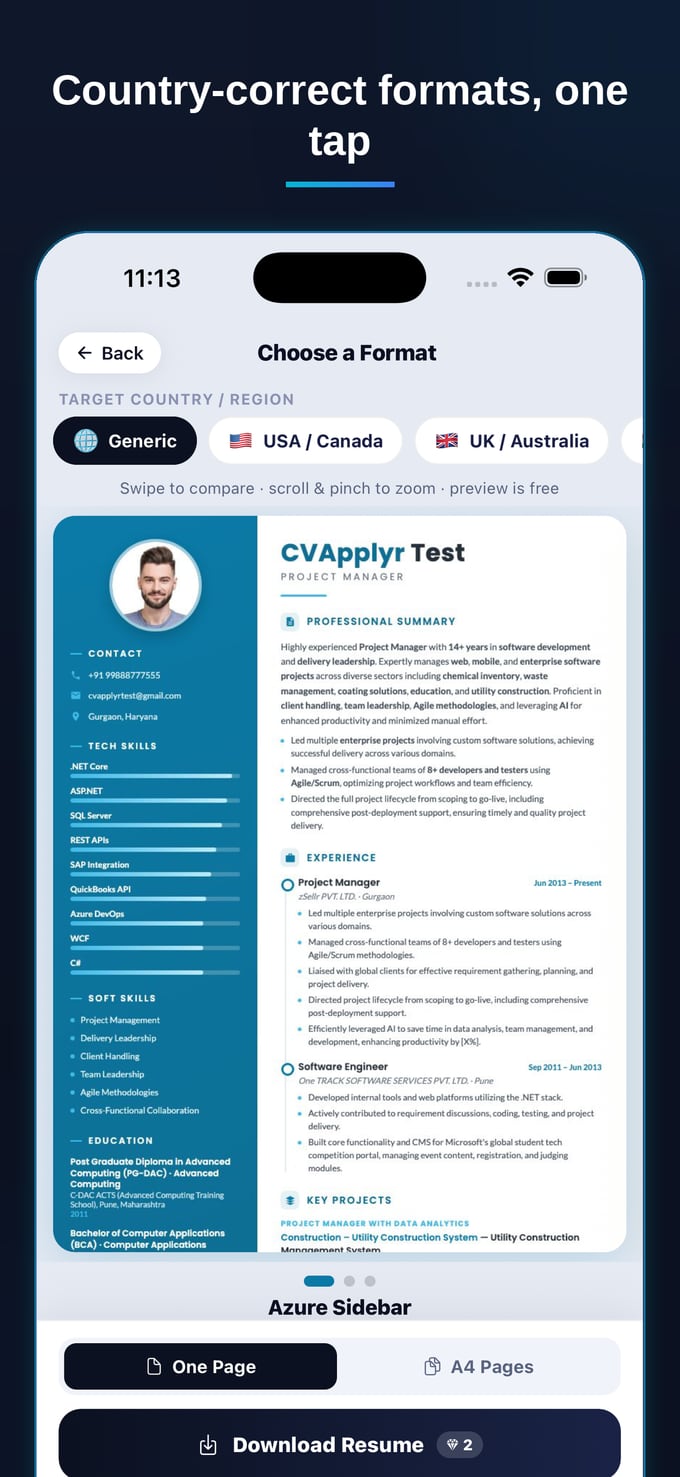
CVApplyr generates a country-correct resume and cover letter for the region you're applying to. You choose the destination, and it produces a document in that market's expected shape — the right length, section order, personal-detail conventions, file type, and wording. The photo goes on (or comes off). The work-authorisation note appears where a local recruiter looks for it. The cover letter adopts the local register. Your experience doesn't change; its packaging does — which is the part that was getting you filtered.
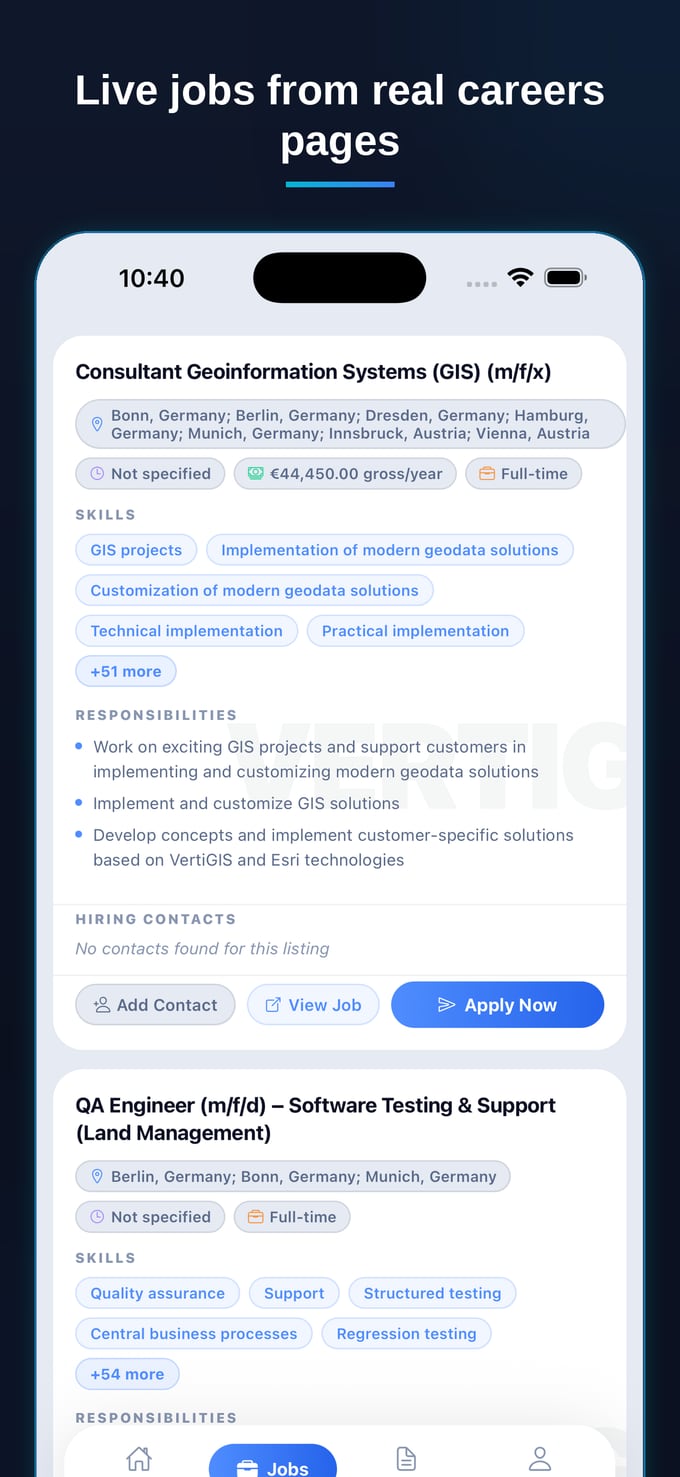
And because the matching jobs CVApplyr surfaces come straight from real company careers pages — including international employers — you can find the role and produce the locally-correct application in the same sitting, instead of stitching together a job board, a translator, and three "resume format by country" blog posts.
Preview first, then download
You're not flying blind. CVApplyr lets you preview the country-correct version before you commit, so you can see exactly how a recruiter in Amsterdam or Sydney will receive it. If the photo placement, the length, or the tone looks right, you download it; if you want to tweak a line, you tweak it. No guessing, no "I hope this is how they do it over there."
Put those numbers together and the stakes are clear. With hundreds of applicants per role, a six-second human glance, and an ATS gate in front of it, a resume that doesn't fit the local mould has almost no room for the benefit of the doubt. Abroad, the format is the first impression — and you want it working for you, not against you.
Your qualifications already crossed the border. Don't let a one-page-versus-two-page convention be the reason no one ever reads them.
What this looks like in practice
Say you're in the US, applying for a role in Munich. The old way: dig up how German CVs are supposed to look, wonder whether the photo is really expected, guess at the section order, translate your cover letter's tone, and send it half-confident. The CVApplyr way: pick Germany, get a Lebenslauf-shaped resume with the photo and personal-detail conventions handled and a cover letter pitched at the right formality, preview it, and apply — directly to the company's careers page, with the whole thing tracked so you can follow up. Same career, packaged for the market that's actually hiring.
Do that across a few countries and the difference compounds. Instead of a pile of silent rejections you can't explain, you get applications that clear the format filter and actually reach the people deciding — which is the entire point of applying in the first place.
Apply abroad like a local
Generate a country-correct resume and cover letter for the region you're targeting, find international roles from real careers pages, and track every application — free to start.
Download CVApplyrFrequently asked questions
Why do international job applications get auto-rejected?
Usually because of a format or detail mismatch the local recruiter — and the ATS behind them — expects but doesn't find. A two-page US-style resume sent to a country that expects a one-page CV, a missing work-authorisation note, or a date format the system can't parse can all trigger a quiet filter long before a human reads a word. It's rarely about your experience; it's about meeting the local convention.
Do resume formats differ by country?
Yes, significantly. Length, section order, whether you include a photo or personal details, the file type, and even what the document is called (resume vs. CV) all vary by region. A document that looks polished at home can read as off or incomplete abroad, which is exactly the kind of mismatch that gets applications screened out.
Should I include a photo or personal details abroad?
It depends entirely on the country. In some regions a photo and details like date of birth are expected; in others — notably the US, UK, and Canada — including them can hurt you on anti-discrimination grounds and look unprofessional. The safe move is to match the local norm rather than your home one, which is exactly what country-correct formatting does for you.
How does CVApplyr handle country-specific formats?
You pick the region you're applying to and CVApplyr generates a resume and cover letter in that country's expected format — the right length, section order, personal-detail conventions, and wording — so your application reads like a local one. You can preview it free and download when it looks right.