The Cold Email That Lands Interviews
Most cold emails get ignored not because the candidate is wrong for the job — but because the email asks for too much, says too little, and reads like it was blasted to fifty people.

You found the perfect role. You even found the recruiter's email. So you open a blank message, stare at the cursor for ten minutes, and finally type some version of "Hi, I came across your opening and would love to apply." Send. Then nothing. No reply, no rejection — just silence. It's tempting to conclude that cold emailing doesn't work. The truth is harsher and more fixable: it works, but the email you sent gave them no reason to answer.
A cold email isn't a cover letter you paste into Gmail. It's a 30-second pitch to a stranger who gets dozens of these a week. Get the framing right and a single, specific message can jump you past the applicant pile and straight into a conversation. Let's break down why most cold emails die in the inbox — and the exact structure (with templates) that gets a reply.
Why most cold emails get ignored
Recruiters and hiring managers aren't ignoring you out of rudeness. They're triaging. A typical opening can attract around 250 applicants, so the person on the other end has trained themselves to skim fast and delete faster. Three things get an email deleted on sight:
- It's generic. "I'm a hard worker passionate about your mission" could have been sent to anyone, so it reads like it was.
- It's all about you. Three paragraphs of your life story before they understand why you'd help them.
- The ask is huge. "Can we hop on a call this week?" from a total stranger is a big yes to give. Big asks get postponed, and postponed means forgotten.
Notice none of these are about your qualifications. You can be exactly right for the job and still get ignored because the email made you easy to skip. The fix is structural, not a matter of writing more.
The 5-part framework that gets replies
Every cold email that lands an interview tends to hit the same five beats, in this order. Keep the whole thing under about 130 words.
1. A subject line that names the role
No clever hooks. Say exactly what this is: "Application — Senior Data Analyst (5 yrs, SQL/Python)". It tells a busy recruiter what's inside before they open it, and it surfaces later when they search their inbox.
2. One specific opener
Reference the actual role and one real detail — the team, a recent product, the exact requisition. This single line proves you're writing to them, not bcc'ing the world: "I saw you're hiring a Senior Data Analyst on the Growth team — building the dashboards that the new pricing experiments run on is exactly the work I do now."
3. Two or three proof points
Match yourself to the job description with concrete, quantified wins — not adjectives. "Cut report turnaround from 3 days to 4 hours by rebuilding the ETL" beats "detail-oriented and proactive." Two or three lines is plenty; the attachments carry the rest.
4. A small, specific ask
Make saying yes nearly effortless: "Is this role still open, and are you the right person to send my application to?" A yes/no question gets answered far more often than "let's find time to chat."
5. The documents, attached
End by noting that your resume and a short cover letter are attached. This is the part most people skip — and it's what turns a cold email into an application a recruiter can act on without asking you for anything.
Copy-paste templates
Here are two you can adapt today. Swap in the real role, the real detail, and your own numbers — the specifics are what make them work.
Template A — emailing a recruiter
Subject: Application — Senior Data Analyst (5 yrs, SQL/Python)
Hi Priya,
I saw you're hiring a Senior Data Analyst on the Growth team. Building the dashboards behind pricing experiments is exactly what I do now, so I wanted to reach out directly.
A couple of quick proof points: I cut report turnaround from 3 days to 4 hours by rebuilding our ETL, and the self-serve dashboards I shipped are used weekly by 40+ people across product and finance.
Is this role still open, and are you the right person to send my application to? I've attached my resume and a short cover letter so it's all in one place.
Thanks for the read,
Sam
Template B — emailing the hiring manager directly
Subject: Re: your Growth Analyst opening — quick intro
Hi Daniel,
Your Growth Analyst role caught my eye — the bit about owning the experimentation pipeline is the part of my current job I like most.
In my last role I ran 60+ A/B tests and built the reporting layer that the whole team used to call them, which cut "is this significant yet?" debates to near zero.
Would it be worth me throwing my hat in? Resume and a short cover letter are attached — happy to share more if it's useful.
Best,
Sam
Both are under 110 words. Both open with a specific detail, prove fit in two lines, ask one small question, and attach the documents. That's the whole game.
The hard part: actually doing this at scale
Here's the catch. Writing one great cold email is doable. Writing a fresh, genuinely specific one for every role — finding the right contact, re-quantifying your wins against each job description, attaching a tailored resume and letter each time — is where the system collapses. By the fifth email you're tired, and tired emails are generic emails. So most people either send a handful of careful ones or a pile of lazy ones. Neither fills your calendar.
This is exactly the repetitive-but-judgment-heavy work software is built to absorb — and it's where CVApplyr fits in.
How CVApplyr drafts the outreach for you
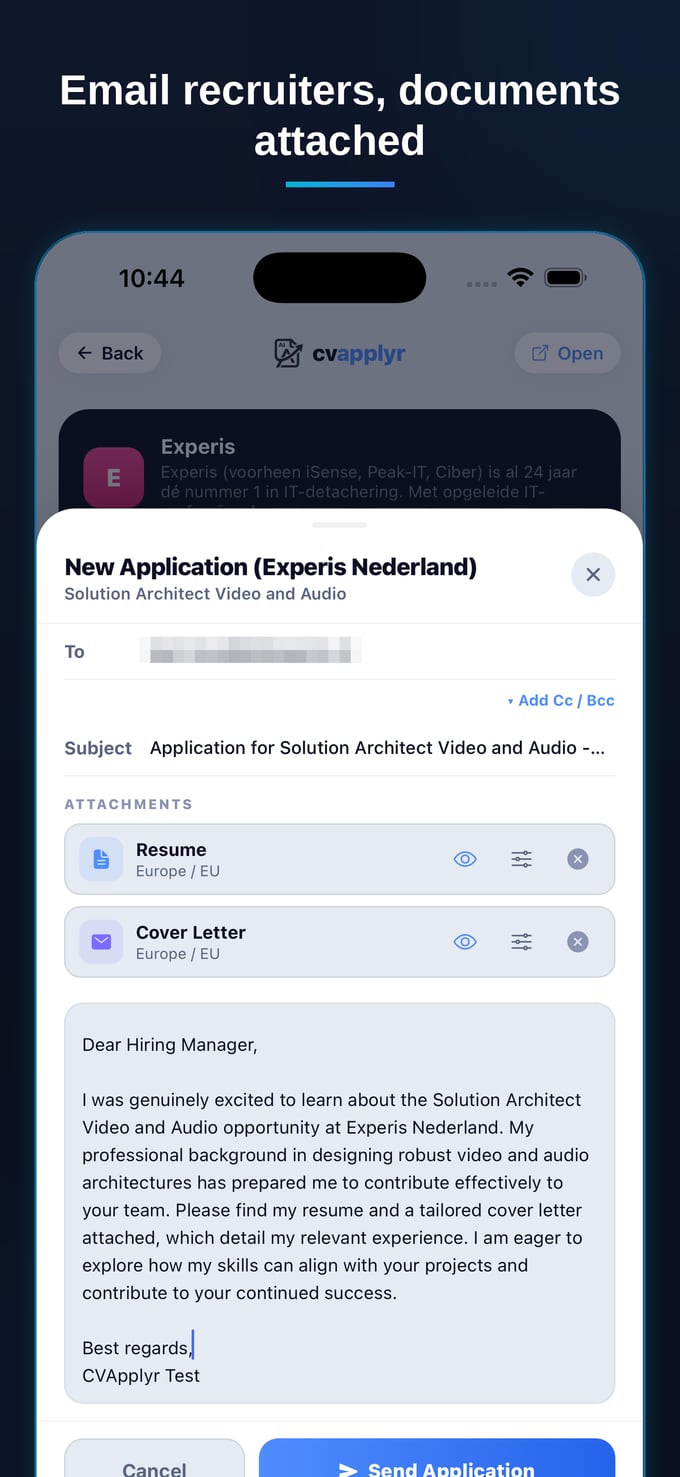
When CVApplyr surfaces a recruiter or hiring-manager contact for a role, you don't start from a blank message. It drafts an AI outreach email tuned to that person and that job — a specific opener, proof points pulled from your resume that match the description, and a small, clear ask — then attaches your tailored resume and cover letter automatically. You review the draft, tweak a line if you want it more in your voice, and send. The screenshot at the top of this article is that exact composer: contact, AI-written body, and both documents already attached.
The point isn't to remove you from the loop — your judgment on which roles to chase and how to sound is the part that matters. It's to remove the 20 minutes of friction between "I found the right person" and "the email is out," so doing this for ten roles feels like doing it for one.
A cold email doesn't have to be clever. It has to be specific, short, and easy to say yes to. Attach the proof, ask one small question, and you've already beaten most of the inbox.
A few rules that keep replies coming
Once the structure is right, these small habits move the needle:
- Send it fresh. The same-day a relevant role goes live beats a polished email a week later.
- One follow-up, not five. A single, friendly nudge after four or five business days catches the ones who meant to reply. Beyond that you're just annoying.
- Make the attachments do the heavy lifting. Keep the body short; let the tailored resume and cover letter carry your detail.
- Reach a person, not a portal. An email in a real inbox beats one buried in an applicant-tracking system — that's the entire reason cold outreach works.
Send the cold email that gets answered
Let CVApplyr surface the right contact, draft the outreach, and attach your tailored resume and cover letter — free to start.
Download CVApplyrFrequently asked questions
What should a cold email to a recruiter say?
Open with one specific reason you're writing to them about this role, give two or three concrete proof points that match the job, attach your tailored resume and cover letter, and end with a low-pressure ask. Keep it skimmable and make it obvious you're not mass-blasting.
How long should a job cold email be?
Short — roughly 80 to 130 words, or about five to seven sentences. A busy recruiter reads it on a phone between meetings, so a single screen with one clear ask beats a wall of text every time. Let the attached resume and cover letter carry the detail.
When is the best time to send a cold email?
Aim for a weekday morning in the recipient's time zone, typically Tuesday to Thursday, when inboxes are being actively worked. Avoid late Friday and weekends. More important than the perfect hour is sending it the same day a relevant role goes live, while it's fresh.
Can CVApplyr write and send the outreach for me?
Yes. When CVApplyr surfaces a recruiter or hiring-manager contact for a role, it drafts an AI outreach email tuned to that person and job, and attaches your tailored resume and cover letter. You review, tweak a line if you like, and send.