Why Your Applications Get Ghosted (and How to Get Replies)
You did everything right — tailored the resume, wrote the letter, hit submit. Then nothing. The silence usually isn't about you. It's about where your application landed.

You spend an hour on an application you actually care about. You tweak the resume, write a cover letter that sounds like you on a good day, double-check the form, and hit submit. Then you wait. A week passes. Two. You refresh your inbox like it owes you money. And the only thing that ever arrives is an automated "we'll be in touch" that, deep down, you already know means nothing. It's not just discouraging — it's confusing. You don't even know if a human read a single word.
Here's the part nobody says out loud: getting ghosted is almost never a verdict on you. It's a side effect of how modern hiring is plumbed. Once you understand where your application actually goes after you hit submit, the silence stops feeling personal — and you can start doing the one thing that reliably breaks it.
Where your application really goes after "submit"
When you apply through a typical careers page or job board, you're rarely sending a message to a person. You're feeding a database. That database is an applicant-tracking system (ATS), and the great majority of mid-size and large employers use one to manage the flood. Your carefully written application becomes a row in a list — one of hundreds.
And it really is hundreds. The average corporate opening draws roughly 250 applicants, and only a small handful ever reach an interview. Before a recruiter even opens the pile, filters and keyword rules have already thinned it. If your resume survives that, it earns a first human pass that eye-tracking research clocks at about six to seven seconds. Six seconds. That's the entire audition.
So picture the math from the other side of the desk. A recruiter opens a requisition with 250 entries, leans on filters to get to a shortlist, and spends a few seconds each on the survivors. Replying personally to the other ~240 people is, realistically, never going to happen. It's not cruelty. It's triage. The "ghost" is just the gap between how much you cared and how little bandwidth there was to care back.
Why "apply harder" doesn't fix it
The instinct after a ghosting streak is to grind: send more applications, polish the resume one more time, watch another video about power verbs. None of that is wrong, exactly — a tailored resume genuinely helps you survive the scan, and you absolutely should tailor. But if every application keeps entering through the same crowded front door, you're optimizing for a six-second glance that may never come. You're competing for attention in the one place where attention is scarcest.
The job seekers who get replies aren't necessarily more qualified. They've often just found a second door. They get their application in front of an actual human — a recruiter or the hiring manager — instead of trusting the queue to surface them. That single move changes the physics of the whole thing.
The fix: get in front of a real human
An email sitting in a recruiter's inbox is a fundamentally different object than a row in their ATS. One has a name on it and a face behind the name. It can be replied to with one tap. The other is an anonymous record they have to go looking for. The hard part has never been wanting to reach a person — it's finding the right person and then having something worth sending them. That's exactly the gap CVApplyr is built to close.
1. Find the person attached to the role
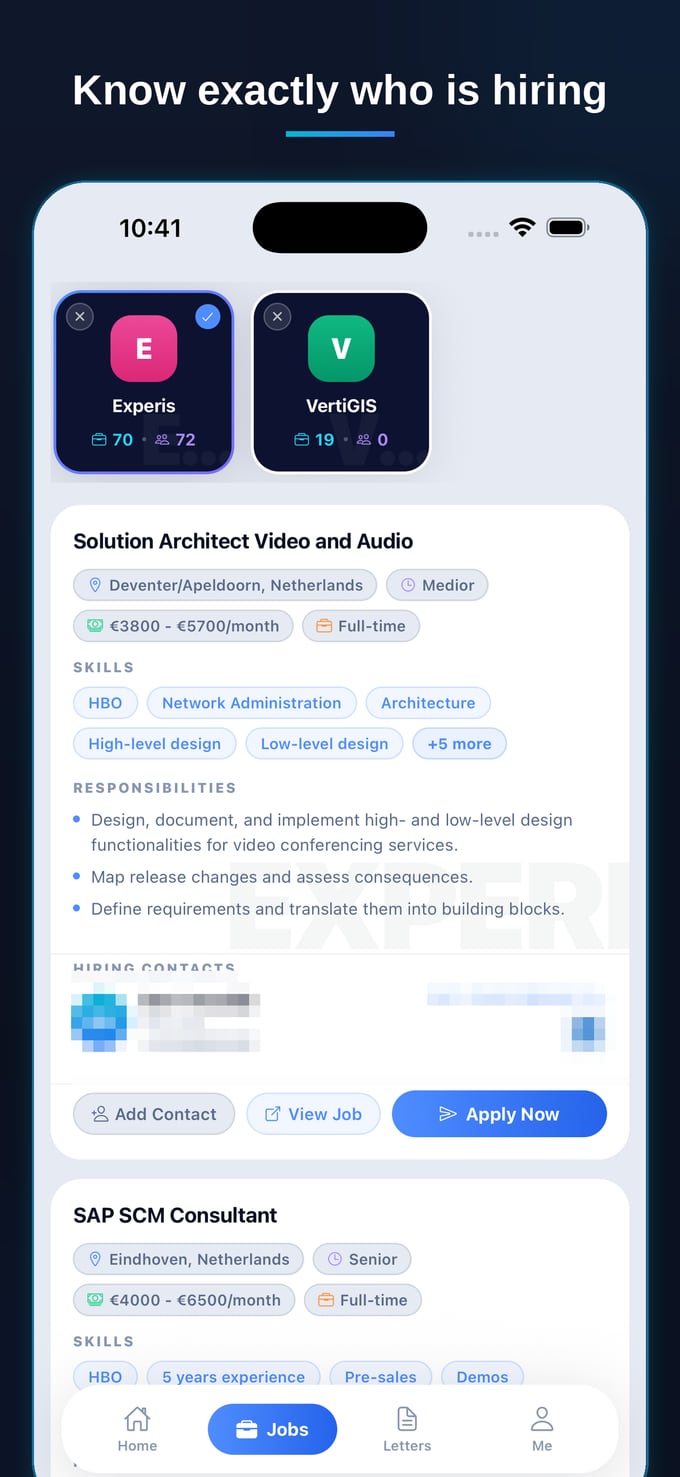
For a given opening, CVApplyr surfaces a recruiter or hiring-manager contact where one is available — right alongside the job, with the option to add your own. Instead of "submitted, fingers crossed," you've got a name and a way to reach them. You're no longer applying at a company; you're reaching out to someone in it.
2. Show up with something worth opening
Reaching a person only helps if what you send is sharp. CVApplyr reads the job description and your background and writes a cover letter tuned to that role, plus a country-correct resume — so your message survives the six-second scan and reads like it was meant for them, because it was. No generic "Dear Hiring Manager" landing in a stranger's inbox.
3. Send it straight to their inbox
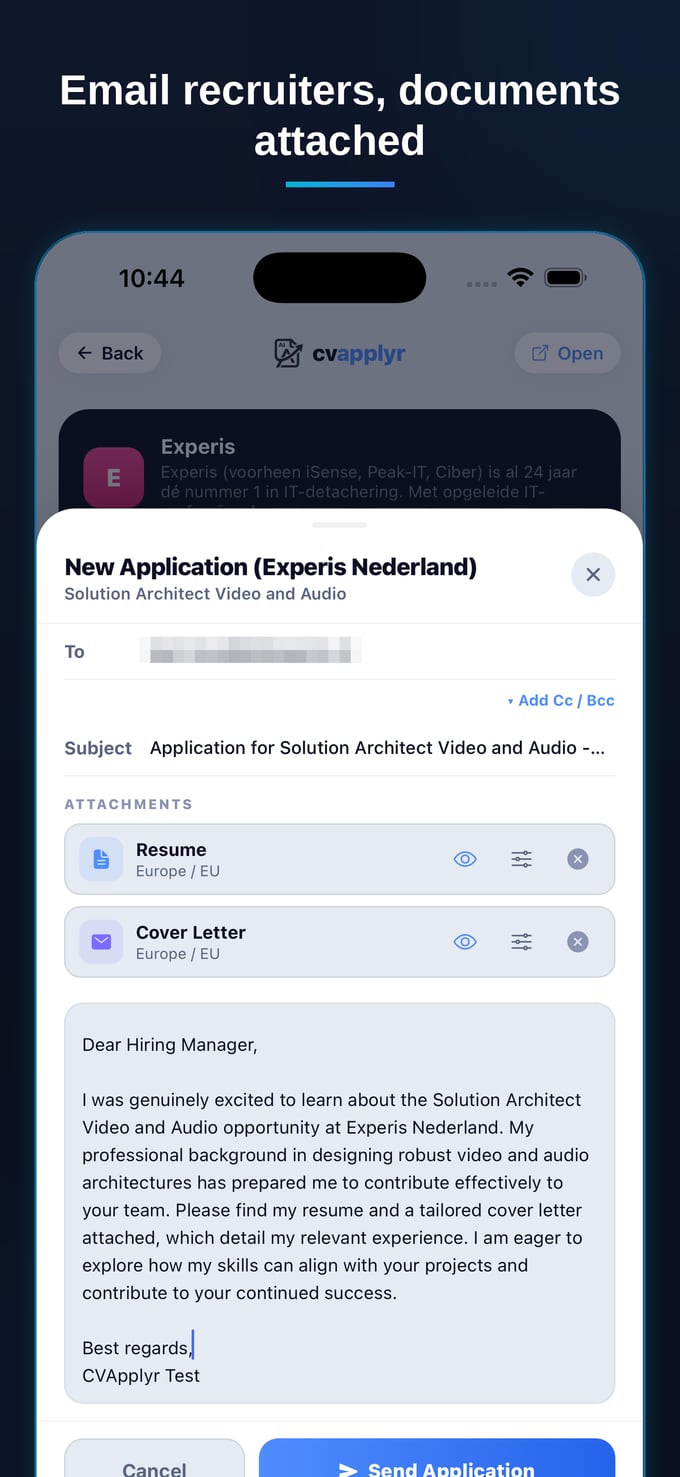
This is where the queue stops mattering. CVApplyr lets you email the recruiter or hiring manager directly with your resume and cover letter already attached and an AI-drafted note you can adjust in your own words. Your application now arrives as a message from a candidate, not as entry #173 in a tracking system. That's the difference between hoping you were seen and knowing you were.
You can't out-write a black hole. You can only step out of it. The moment your application has a human name on the other end, "did anyone even see this?" stops being the question.
What changes when you do this
Switching from "submit and wait" to "reach a person" doesn't guarantee a yes — nothing does, and anyone promising one is selling something. What it does is change which outcomes are even possible. A row in a database can only be ignored or, occasionally, surfaced. A thoughtful note to a named recruiter can be replied to, forwarded to a hiring manager, or filed for the next opening. You trade a lottery ticket for an actual conversation. Even a polite "not this one, but stay in touch" is infinitely more useful than three weeks of nothing — it's a door left ajar instead of a wall.
And it compounds. Every direct contact you make is a relationship, not a transaction. The recruiter who passed on you for one role is the same person staffing the next three. None of that happens when you're an anonymous entry in a queue. All of it becomes possible the moment there's a person on the other end.
Stop applying into the void
Find a real recruiter or hiring-manager contact for a role, send a tailored resume and cover letter straight to their inbox, and track every reply — free to start.
Download CVApplyrFrequently asked questions
Why do companies ghost job applicants?
Usually not malice — it's volume. A single opening can draw around 250 applicants, most filtered automatically by an applicant-tracking system before a human ever looks. Recruiters triage the shortlist and rarely have time to reply to everyone else, so silence becomes the default. Reaching a real person directly is how you step out of that pile.
Does applying through job boards hurt my chances?
Job boards are fine for discovery, but the one-click apply often drops you straight into the ATS with hundreds of others, where a 6–7 second scan decides your fate. Use boards to find roles, then strengthen the application by tailoring it and, where you can, sending it to a named recruiter or hiring manager too.
How do I actually get a reply to an application?
Get in front of a human. Tailor your resume and cover letter to the specific role so you survive the scan, then email a recruiter or hiring manager directly with your documents attached and a short, specific note. A message addressed to a person is far harder to ignore than one more entry in a queue.
How does CVApplyr help me reach a real person?
For a given role, CVApplyr surfaces a recruiter or hiring-manager contact where available, writes a tailored cover letter and resume, and lets you send it straight to that person with both documents attached — so your application lands in an inbox, not a black hole. It's free to start.