Cover Letter Examples That Got Interviews (and Why They Worked)
The best cover letters aren't clever or long. They're specific — they prove, in a few lines, that you read the job and you're the obvious answer to it.

You've stared at the blank box labelled "Cover letter (optional)" and felt your whole application stall. Do you even write one? If you do, what do you say that doesn't sound like every other letter on the planet — "I am writing to express my strong interest in the position of…"? So you either skip it, or you paste a generic paragraph you've reused fifteen times and hope nobody notices. The truth is, a hiring manager can tell, in about two lines, whether a letter was written for them or for everyone.
The good news: the letters that actually earn interviews aren't masterpieces. They follow a simple, repeatable shape. Once you can see that shape, you can copy it — and you'll never face the blank box the same way again. Let's break down what those letters do, line by line, and how to produce one for any role in seconds instead of staring at the cursor.
What a winning cover letter is actually doing
A great cover letter isn't a summary of your resume in paragraph form. The resume already lists what you've done. The letter's only job is to answer one unspoken question in the reader's head: "Why you, for this exact role, right now?" Everything that doesn't serve that answer is filler — and filler is what gets a letter skimmed and forgotten.
Recruiters spend only a few seconds on the first pass over an application (Ladders' eye-tracking study). So the letters that work front-load the answer. They open with the specific role and a concrete reason you fit, prove it fast with one or two results, show you understand the company, and close with quiet confidence. That's the whole structure. Here's each piece.
1. The opener: name the role, drop the cliché
Compare these two openings for the same marketing role:
The second one names the role, references something specific from the posting, and leads with a result. In one sentence it has proven the writer read the job and has done the job. That's the entire game, and most applicants lose it in the first line.
2. The proof: one or two results, not a list of duties
The middle of the letter is where you back up the opener. Don't restate your job titles — pick the one or two accomplishments that map directly to this role and make them concrete. "Improved performance" is invisible. "Rebuilt the onboarding flow and lifted week-one retention from 41% to 58%" is a reason to call you. Numbers, scope, and outcome beat adjectives every time.
3. The "why here": show you understand the company
One genuine line about why this company — a product you actually use, a direction they've announced, a value that matches how you work — separates a tailored letter from a mass-blast. It doesn't need to be flattery. It needs to be specific enough that you couldn't paste it into a different company's letter without it falling apart.
4. The close: confident, not desperate
End by pointing forward, not by apologising. "I'd love to walk you through how I'd approach your first 90 days on the growth team" beats "Thank you for considering my application; I hope to hear from you." One offers value and assumes a conversation. The other asks permission to exist.
Why tailoring is the part that actually moves the needle
You might be tempted to write one excellent letter and reuse it. The problem is that "excellent and generic" still reads as generic — and the data points the other way. Studies suggest that tailoring your letter to the job description measurably lifts callback rates, because the reader can instantly tell the letter was built for their opening, not retrofitted to it.
Here's the catch, and it's the real reason people skip tailoring: doing it well, by hand, for every single application, is exhausting. Reading the posting, hunting for the right details, rewriting the opener, swapping the proof points — that's fifteen minutes per role, and you have forty roles to hit this week. So tailoring quietly becomes the corner everyone cuts. That's the gap worth closing.
Start from a strong example, not a blank page
This is exactly where CVApplyr helps. Instead of leaving you to fight the blank box, it reads the job description and your resume and drafts a cover letter built around that role — structured the way the examples above are: a specific opener, proof that maps to the posting, a genuine "why here," and a forward-looking close. You're not starting from zero or from a stale template; you're starting from a tailored, structurally-sound draft you can send or sharpen.
How it works, step by step
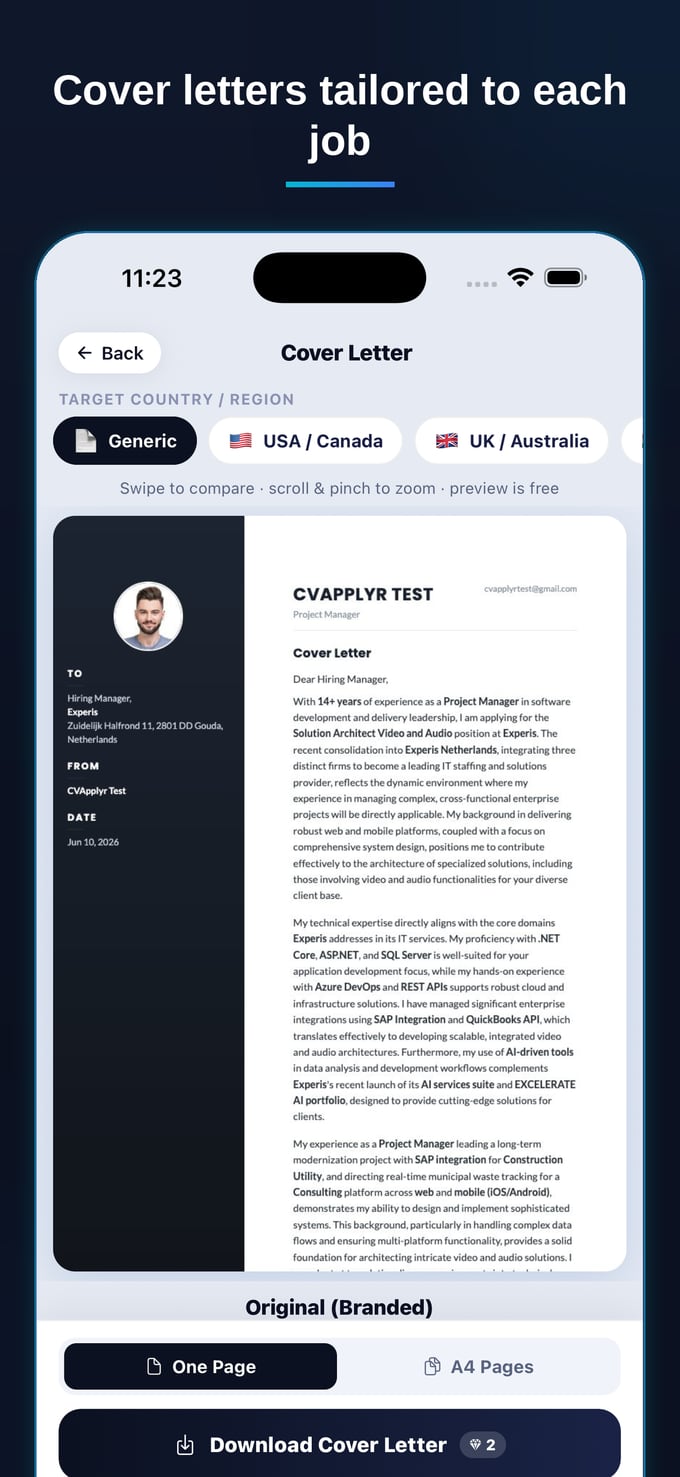
You pick a role from the jobs CVApplyr matched to your resume and tap to generate the letter. In a few seconds you have a draft that names the role, pulls in the right accomplishments from your background, and reads like you wrote it on a focused morning — because the structure that works is already baked in. You skim it, adjust a line to sound exactly like you, and it's ready to attach.
The screenshot at the top of this article is that preview in the app: a clean, specific letter, with a country and region picker so the tone and format match where you're applying. The point isn't to remove you from the process — it's to delete the blank-page paralysis and the fifteen-minute rewrite, so the only thing you spend energy on is the judgment call: does this sound like me, and does it sell me for this role?
A cover letter doesn't have to be brilliant to work. It has to be specific. Start from a draft that already knows the job, and "specific" stops being the hard part.
Putting it together: a quick before-and-after
Take the generic opener from earlier and run the same role through this structure. The "before" is the letter most applicants send: a polite paragraph that could go to any company. The "after" names the role in line one, proves fit with a result by line two, shows it knows the company by line three, and closes by offering a conversation. Same applicant, same career — completely different read. The difference isn't talent. It's tailoring, applied consistently, which is precisely the thing that's hard to keep up by hand and easy to keep up when the first draft is done for you.
Never face the blank box again
Generate a tailored, structurally-sound cover letter for each role — start from a strong example, free to start.
Download CVApplyrFrequently asked questions
What makes a cover letter actually get read?
Relevance in the first two lines. A reader decides whether to keep going almost instantly, so the opening has to name the specific role and lead with something concrete about why you fit it — a result, a matching skill, a genuine reason you want this job at this company. Clichés and generic openers get skimmed past; specifics get read.
How long should a cover letter be?
Short — roughly 150 to 250 words, or three to four tight paragraphs that fit on one screen. A hiring manager reading dozens of applications won't work through a full page of prose. Make every line earn its place: one strong opener, one or two proof points, and a confident close.
Should every cover letter be different?
Yes. The whole point of a cover letter is to connect your background to one specific role, and studies suggest tailoring to the job description measurably lifts callbacks. You don't have to rewrite from scratch every time, but the company name, the role, and the two or three things you emphasise should change with each application.
Can CVApplyr write a tailored letter for each job?
Yes. CVApplyr reads the job description and your resume and drafts a structurally-sound, role-specific cover letter for each opening, so you start from a strong example instead of a blank page. You review it, adjust a line if you want, and send. It's free to start.