Tailor a Cover Letter to Any Job in 60 Seconds
A generic letter says you want a job. A tailored one says you want this job. The only thing standing between the two has always been time — so let's take that excuse off the table.

You find a role you actually want. You open a blank document — or worse, that one cover letter from three weeks ago — and you start the surgery: swap the company name, rewrite the opening so it doesn't sound recycled, dig back through the posting to find the skills they care about, reorder your achievements to lead with the right one. Fifteen minutes later you have one letter, and there are nine more roles on your list. So you do what almost everyone does: you stop tailoring, send the generic version, and quietly hope nobody notices.
Recruiters notice. A letter that could be pasted to any company reads exactly like a letter that was pasted to any company. The fix isn't to write more carefully — it's to make tailoring so fast that there's no reason to skip it. Here's how to get a genuinely specific cover letter in under a minute, by hand or with a little help.
Why tailoring eats so much time
Tailoring feels slow because it's really three small jobs stacked on top of each other, and you redo all three for every role:
- Re-reading the posting to figure out what this employer actually cares about most.
- Choosing your proof — which of your wins maps to those priorities, and which to lead with.
- Rewriting the connective tissue so the letter flows in your voice instead of reading like a list of keywords.
None of these is hard on its own. The cost is that they're repetitive — the same three decisions, from scratch, role after role. That's the part that drains you by the fifth application of the night, and it's exactly the kind of work that can be handed off.
The 60-second tailoring method
Whether you do this by hand or let CVApplyr do it for you, the shape is the same. A tailored letter doesn't need to be rewritten end to end — most of it stays put. You change four things, in this order.
1. The opening hook (the first two lines)
This is the highest-leverage edit. Name the role and the company, and give one concrete reason this job — not just any job — caught your attention. "I've spent three years shipping billing systems, so a Payments Engineer role at Stripe is exactly where I want to be next" beats "I am writing to apply for the position" every single time.
2. The role's top two requirements
Skim the posting for the two or three must-haves that show up first or repeat. Those are the things the hiring team is anxious about. Your job is to answer them directly, using the same words the posting uses — if it says "stakeholder management," don't translate it to "working with people."
3. The proof you lead with
Pick the one achievement that most directly answers those requirements and put it up front. The rest of your story can stay where it is. Leading with the most relevant win is what makes a recruiter think "this person gets what we need," in the six or seven seconds you actually have.
4. A close that fits the company
A light, specific sign-off — a nod to the team's product, mission, or recent news — does more than a formal "I look forward to hearing from you." It's the detail that proves you didn't mass-send.
That's it. Four edits, everything else untouched. Done deliberately by hand, it's a few minutes per letter once you have a base. Done with a tool that already knows your resume and can read the posting, it collapses into seconds.
Where CVApplyr does the four edits for you
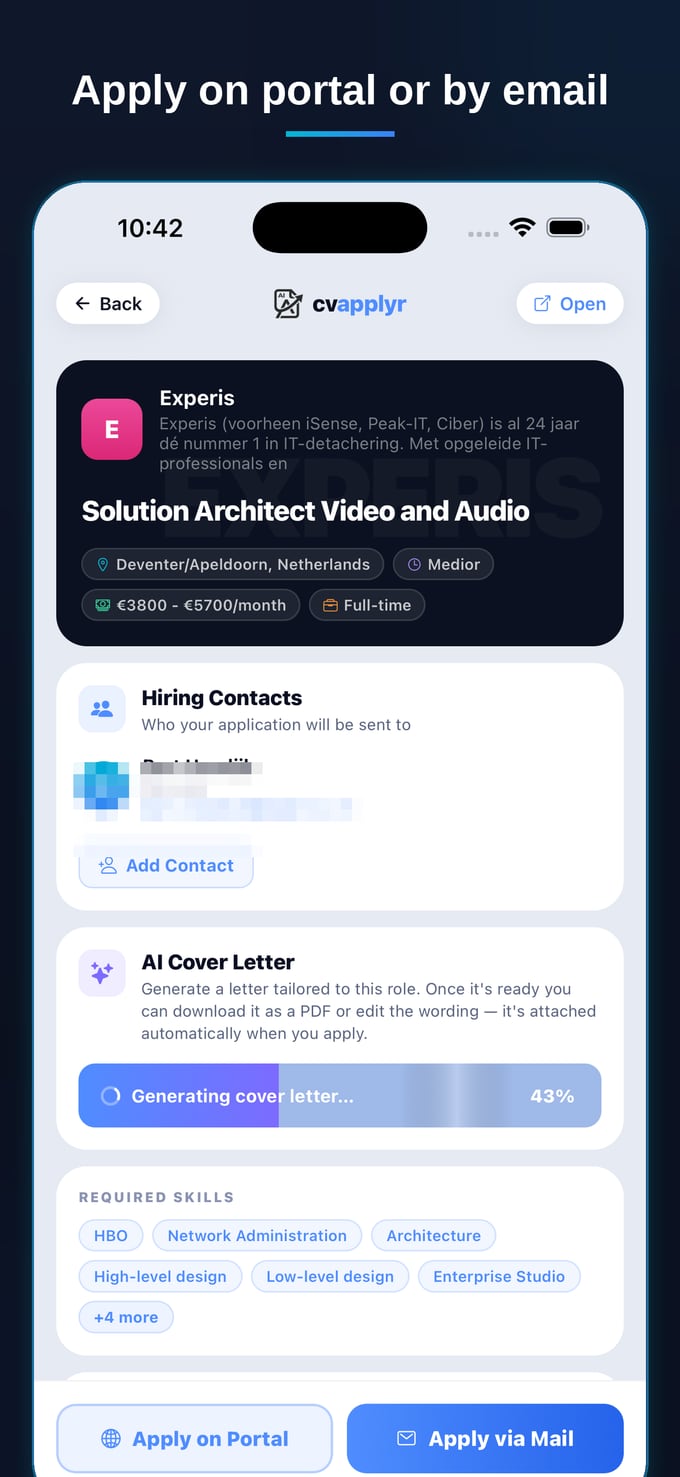
The method above is sound — but doing it manually for ten roles is exactly what burns people out. This is where automation earns its keep, because every one of those four edits is a pattern, not a stroke of genius. CVApplyr reads the specific job description next to your resume and writes a cover letter tuned to that role: it pulls the matching skills, mirrors the posting's language, leads with relevant proof, and keeps your voice. You skim it, tweak a line if you want, and it's ready.
The part that makes it genuinely fast across a whole job hunt: CVApplyr re-tailors your letter to each new job description automatically. Move from one role to the next and a fresh, on-point letter is regenerated and attached — ready the moment you hit apply, whether you're applying on the company portal or sending it by email. You never start from a blank page, and you never send the same letter twice by accident.
Read those numbers together and the logic of tailoring snaps into focus. You spend fifteen minutes crafting a letter that gets a six-second skim — so the only thing that matters is whether the top of that letter instantly signals "right person for this role." Tailoring is what loads the top of the page with the proof a recruiter is scanning for. Automating it means every letter gets that treatment, not just the first two before you got tired.
A cover letter you could send to ten companies unchanged isn't a cover letter — it's a form. The whole value is in the part that's different for this job, and that's the part you keep skipping because it's slow.
What "tailored in 60 seconds" looks like in practice
Picture a normal application session. You've got a shortlist of matched roles. You open the first one, and the letter is already written for it — the opening names the company, the body leads with the experience that fits the posting, the language echoes what they asked for. You read it, nod, maybe sharpen one sentence to sound more like you, and apply. You open the next role and the letter has already re-tailored to that job description. Repeat down the list. Twenty roles later you've sent twenty specific letters in the time it used to take to grind out three generic ones — and you still recognise every letter as yours.
That's the quiet shift: tailoring stops being the bottleneck that makes you cut corners, and becomes the default that happens automatically. You get the callback-lifting benefit of specificity without paying the fifteen-minutes-a-letter tax for it.
Tailor your next letter in under a minute
Let CVApplyr read the job, match it to your resume, and write a specific cover letter that re-tailors to every role — free to start.
Download CVApplyrFrequently asked questions
How do I tailor a cover letter quickly?
Start from a strong base letter and change only the parts that are job-specific: the opening hook, the company name and why this role, and one or two achievements that map to the job description's must-haves. Leave your voice and structure intact. Doing this by hand takes a few minutes once you have a template; an AI that reads the job description and your resume can do it in seconds.
What parts of a cover letter should change per job?
The opening line, the company and role name, the specific reason you want this job, and the one or two proof points you lead with — chosen to match the role's top requirements. Your contact details, overall tone, and closing can stay the same. If a letter could be sent to ten companies unchanged, it isn't tailored.
Is a tailored cover letter really worth it?
Yes — a letter that names the role, mirrors the job's language, and leads with relevant proof reads as if you actually want this job, not just any job. Tailoring to the job description measurably lifts callback rates in studies, and it's the difference between a generic letter a recruiter skims and one that earns a closer read. The catch is time, which is exactly the part that can be automated.
How does CVApplyr tailor a letter in seconds?
CVApplyr reads the specific job description alongside your resume, then writes a cover letter tuned to that role — pulling in the matching skills, mirroring the posting's language, and keeping your voice. When you move to a different job it re-tailors automatically, so a fresh, on-point letter is attached and ready the moment you apply.