Do Cover Letters Still Matter in 2026?
Half the internet says they're dead. The other half swears they got an interview because of one. The honest answer is more useful than either — and it changes once writing one stops costing you anything.

You're staring at an application with an optional cover-letter field, and the same tired debate starts in your head. Half the advice online says cover letters are a relic nobody reads. The other half insists a great one is what got them the call. So you do the thing everyone does: you leave it blank, click submit, and quietly wonder if you just threw away your shot. Multiply that hesitation across dozens of applications and it's no wonder the question feels exhausting.
Here's the part both camps get wrong. The real question was never "do cover letters work?" It was "is a cover letter worth 15 minutes of my evening for this role?" Those are completely different questions — and once you separate them, the answer gets clear fast. Let's look at what the data actually says, when a letter earns its place, and why the whole calculation flips when the writing cost disappears.
What hiring managers actually do with your letter
The death-of-the-cover-letter narrative isn't made up — it's just overstated. Plenty of recruiters genuinely never open them, especially at high-volume employers where a resume screen runs first. But "plenty" isn't "most," and the surveys that get quoted as proof of death usually show something more interesting: a split.
So when someone reaches for a flat "nobody reads cover letters," they're describing a real slice of the market — not the whole of it. A meaningful share still reads them, and a notable group says a strong letter can tip a borderline decision your way. That's the asymmetry that matters: a good letter rarely hurts you, and sometimes it's the deciding factor.
The hidden cost that made everyone quit writing them
Be honest about why you skip the optional field. It's not because you ran the data and concluded letters don't work. It's because a good one takes 10 to 15 minutes — rereading the posting, finding an angle, drafting, cutting, rewriting the opener for the fourth time — and you've got nine other applications to send tonight. So the rational move is to skip it and hope the resume carries you.
That instinct is sound when each letter is expensive. The problem is that the "is it worth it?" math has quietly inverted. Here's what the decision used to look like, and what it looks like now.
When a letter costs 15 minutes, "skip it" is a defensible bet across a stack of applications. When it costs 30 seconds, skipping a free chance to influence a real reader stops making any sense. You're no longer weighing effort against payoff — you're just deciding whether to take a no-cost shot. Almost always, you take it.
When to include one — and when to skip
Cheap doesn't mean automatic. A modern, useful answer still has edges. Here's a clean rule of thumb.
Include a letter when
The posting asks for one (obviously), the field is marked optional (treat that as a soft yes), you're a slightly non-obvious fit and want to connect the dots, you're changing fields or industries, or you're emailing a real person directly rather than dropping into a portal. In every one of these, a few specific sentences do work your resume bullets can't.
Skip it when
The application explicitly says "no cover letter," a separate field would only echo your resume word-for-word, or a fast referral makes a formal letter feel stiff and slow. Those are the genuine exceptions — and they're narrower than the "I just didn't feel like it" version most people actually use.
The cover letter never died. What died was the willingness to spend fifteen minutes on something that might get skimmed. Remove the fifteen minutes, and the willingness comes right back.
How CVApplyr makes "include it" the easy default
This is the part that changes the calculation. CVApplyr removes the cost of writing a cover letter, so including a strong one is no longer a decision you have to agonize over — it's just there when you want it. Here's how that works, step by step.
1. It drafts from the actual job — not a template
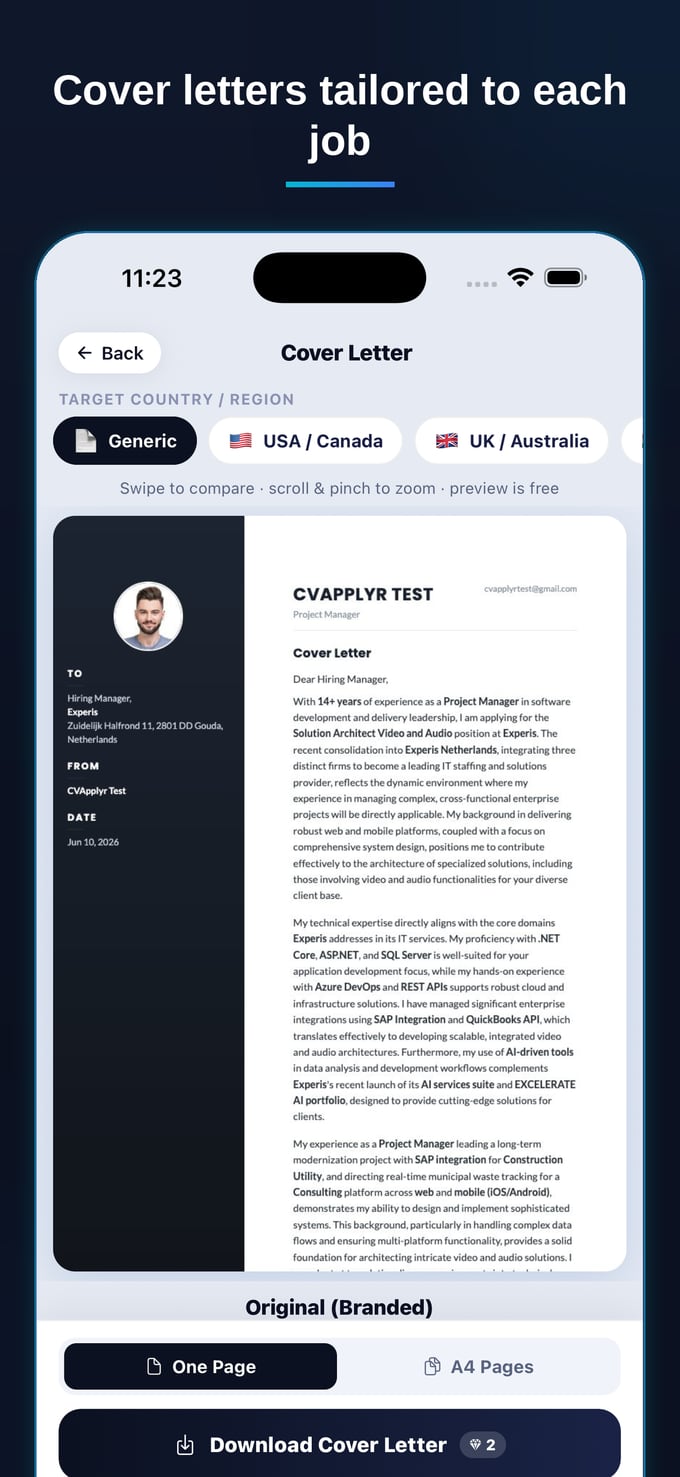
CVApplyr reads the specific job description and your resume, then writes a letter tuned to that role: why this company, why this role, and a concrete proof point that maps to what they're hiring for. No blank page, no generic "I am writing to express my interest." You start from a real draft that's already on-topic.
2. It comes out country-correct and in your voice
A cover letter that reads as generic AISpeak helps no one. CVApplyr's draft is short — the modern three-paragraph shape — phrased like a person and formatted to the conventions of the region you're applying in, so it doesn't trip the "this was clearly auto-generated" instinct on the first line. You skim it, tweak a sentence if you want, and it's ready.
3. It's free to produce, so you stop rationing
Because generating a letter is fast and free to start, you never have to ration them across an evening of applications. Every role that might benefit from a letter gets one — no triage, no "I'll skip this one to save time." The optional field stops being a tax and becomes a free edge you take by default.
4. It plugs straight into how you apply
The letter sits right where you need it — alongside the matched job and the hiring contact — so you attach it and send in the same flow, whether you're applying on a portal or emailing a recruiter directly. No copy-pasting between tabs, no separate document to wrangle.
Stop debating the cover letter
Generate a tailored, country-correct cover letter in seconds, then send it with your application — free to start.
Download CVApplyrThe honest 2026 answer
Do cover letters still matter in 2026? Yes — to a real and sizeable share of the people reading your application, and especially when you're a non-obvious fit or reaching a human directly. They were never the magic key some advice pretends, and never the dead weight other advice claims. They're a low-cost way to tip a close call your way. The only thing that ever made them feel optional was the time they took. Take that away, and the smart move is simple: include a strong one whenever it might help — and let it cost you nothing.
Frequently asked questions
Do employers still read cover letters?
Many do — just not all, and not always closely. Surveys consistently find a meaningful share of hiring managers still read cover letters, and a notable group says a strong one can tip a close decision. Plenty skim or skip, especially at high-volume employers. The practical takeaway: a good letter rarely hurts and sometimes helps, so the only real cost is the time it takes to write — which is exactly the cost CVApplyr removes.
When should I skip the cover letter?
Skip it when the application explicitly says "no cover letter," when a separate field would only repeat your resume, or when a fast-moving referral makes a formal letter feel stiff. If the form marks it optional, treat that as a soft yes rather than a no — an optional letter is a low-risk chance to add context a resume can't. When it's free to produce one, "optional" almost always means "include it."
What should a 2026 cover letter focus on?
Three things: why this company, why this role, and one concrete proof point that maps to the job description. Skip the throat-clearing and the resume rehash. A modern letter is short — three tight paragraphs — specific to the posting, and written in your own voice rather than generic AI filler. CVApplyr drafts from the actual job description and your resume so the focus is built in from the first line.
Does CVApplyr make cover letters worth including?
That's the whole point. The reason people skip cover letters is the 15 minutes each one costs, not a belief they never help. CVApplyr reads the job description and your resume and writes a tailored letter in seconds, country-correct and in your voice, so including a strong one costs you almost nothing. When the cost drops to near zero, "should I bother?" stops being a question — you just include it whenever it might help.