How to Explain Employment Gaps on Your Resume
The break isn't what costs you the interview. The blank space where an explanation should be — that's what costs you the interview.

There's a particular kind of dread that comes with a fourteen-month hole in your work history. You've rewritten the dates four times. You've considered fudging a month. You've wondered whether to bury it, pad it with a freelance project that was really two invoices, or just hope nobody notices. And every time you send the application anyway, you spend the next week assuming that was the reason you never heard back.
Here's the reframe that makes this much easier: hiring managers are not scandalised by career breaks. They've had them. Their colleagues have had them. What they can't work with is ambiguity — a silent stretch of calendar that they have to fill in themselves, in about six seconds, with no information from you. This guide is about closing that gap in the reader's mind, not hiding the gap in your history.
Why a gap feels bigger to you than it looks to them
You've lived every week of that break. You know exactly what it cost you and what it was for. The person reading your resume knows none of it, and — this is the uncomfortable part — isn't going to spend long trying to find out. Eye-tracking research from Ladders found recruiters give a resume roughly six to seven seconds on the first pass. That first pass isn't reading. It's pattern-matching: titles, companies, dates, does this look like the shape of the job.
Six seconds is not enough time to be curious about you. It's barely enough time to notice that 2024 goes straight into 2026 and nothing sits in between. So the reader does what humans do with incomplete information — they fill it in with the most available assumption, and move on to the next of the roughly 250 applicants that Glassdoor found a typical corporate opening attracts.
Look at the difference in what the reader walks away with. Nothing about the underlying facts changed. The candidate on the right still took two years off. They just refused to make a stranger guess.
The four-sentence formula
Almost every good gap explanation does the same four things, in the same order, in well under a hundred words. Once you've written it once, you'll reuse it for the rest of your search.
1. Name it plainly
Use a clear label and real dates: Career break, Parental leave, Full-time caregiving, Personal leave, Redundancy following a restructure. Plain language reads as confidence. Vagueness reads as evasion, and evasion is the one thing that genuinely damages you here. Notice that none of those labels requires you to disclose a medical condition, a diagnosis, or a family crisis in detail — you are entitled to keep that private.
2. Say what it was for
One clause is enough. "To care for a parent through treatment." "To relocate after my partner's job moved." "Following a company-wide restructure that closed my department." A reason — any honest reason — converts a suspicious blank into an ordinary life event. Most gaps are, in fact, ordinary life events.
3. Show you stayed connected to the work
This is the sentence that does the heaviest lifting, and the one most people skip because they think it needs to be impressive. It doesn't. A course, a certification, a volunteer role, freelance work, a side project, keeping up with the industry — any evidence that your skills didn't go dormant. If you genuinely did nothing work-related, say what you're doing now instead: the refresher you're taking, the tooling you've been rebuilding your hands on.
4. Land on why you're here now
Close forward, not backward. "That's now settled and I'm returning to analytics full time — which is why this role stood out." The reader's real question was never "what happened?" It was "is this person available, focused, and ready?" Answer that one directly and the gap stops being the topic.
Where each version of the story belongs
People tend to make one of two mistakes: they say nothing anywhere, or they pour the entire saga into the cover letter's opening paragraph. Neither works. The story belongs in three places, at three different lengths.
On the resume — one line, no feelings. Add the break to your experience timeline exactly like a role, with a label and dates: Career Break — Full-time caregiving · Mar 2024 – Jun 2026. If you have something concrete from the period, give it a single sub-bullet. This matters mechanically too: many mid- and large-size employers screen with an applicant-tracking system, and a labelled entry keeps your timeline continuous and parseable instead of leaving a hole for a human to interpret later.
In the cover letter — two sentences, then pivot. Not the opening. Put it in the second half, once you've already established you can do the job, then spend the remaining space on fit. The whole point is proportion: if the gap takes up a quarter of your letter, you've told the reader it's a quarter as important as your experience.
In the interview — the full, calm version. Here you can read the room, answer follow-ups and show that you've genuinely processed it. Practise it out loud once or twice; the goal is to sound like someone recounting a fact, not someone bracing for judgement. Interviewers are largely reading your comfort level, not auditing your reasons — if you're relaxed about it, they will be.
The reason the two-sentence version is so hard to write is that it has to be tailored. A caregiving break reads differently to a hiring manager at a hospital than at a fintech, and the sentence that pivots naturally into "which is why this role" has to point at this role.
Three formatting choices that help, and one that backfires
Use years, not months, if the gap is short. A resume that reads "2021–2024" and "2024–2026" is completely standard and quietly absorbs a four-month gap that "Aug 2024 – Dec 2024" would advertise. This is presentation, not deception — but only use it if you're consistent across every entry.
Label the break as an entry. An explicitly labelled career break looks deliberate. A blank stretch looks like an omission. Same twenty-four months, opposite impression.
Put a short summary at the top. Three lines that state who you are, what you're targeting and that you're returning to work now — so the first thing scanned already contains the answer to the question the dates will raise.
And the one that backfires: inventing freelance work to paper over the gap. Consultancies that can't be verified, a self-employment stretch with no clients you can name — this is the approach that turns a non-issue into a trust problem. It surfaces in a reference check or in one follow-up question at interview, and at that point you're not explaining a break, you're explaining a misrepresentation. An honest gap has never cost anyone an offer the way a discovered fiction does.
Nobody has ever been rejected for taking two years off. Plenty of people have been rejected for making a stranger guess what those two years were.
Let your resume tell the whole story
Build a resume from your own words — break included — and get a tailored cover letter for every role. Free to start.
Download CVApplyrHow CVApplyr handles this for you
The advice above is straightforward. Doing it forty times, once per application, is the part that grinds people down — and returners are often applying in volume precisely because they're restarting. That's the work CVApplyr takes off you.
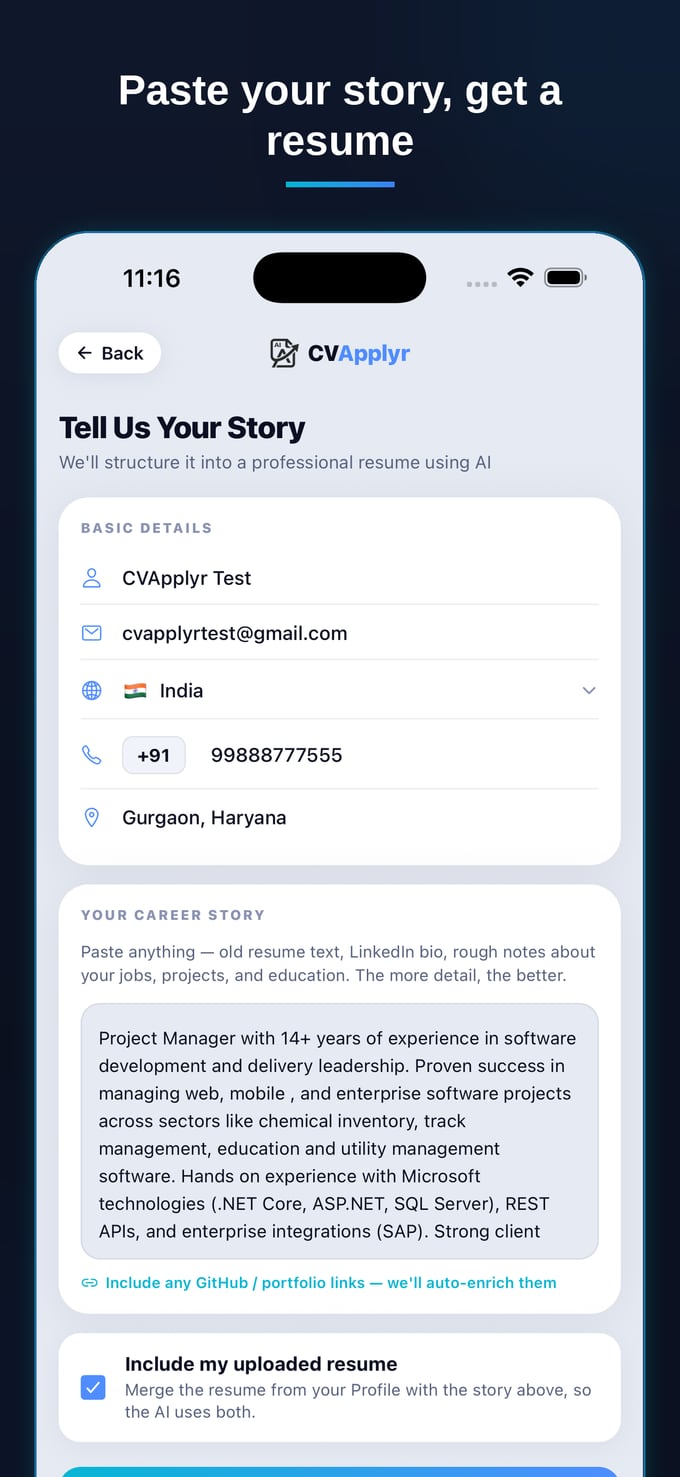
You tell the app your story in plain language, gap and all, and it builds a resume around it — with the break entered as a proper labelled timeline entry, formatted the way employers in your target country expect, rather than left as an awkward hole for a screener to interpret.
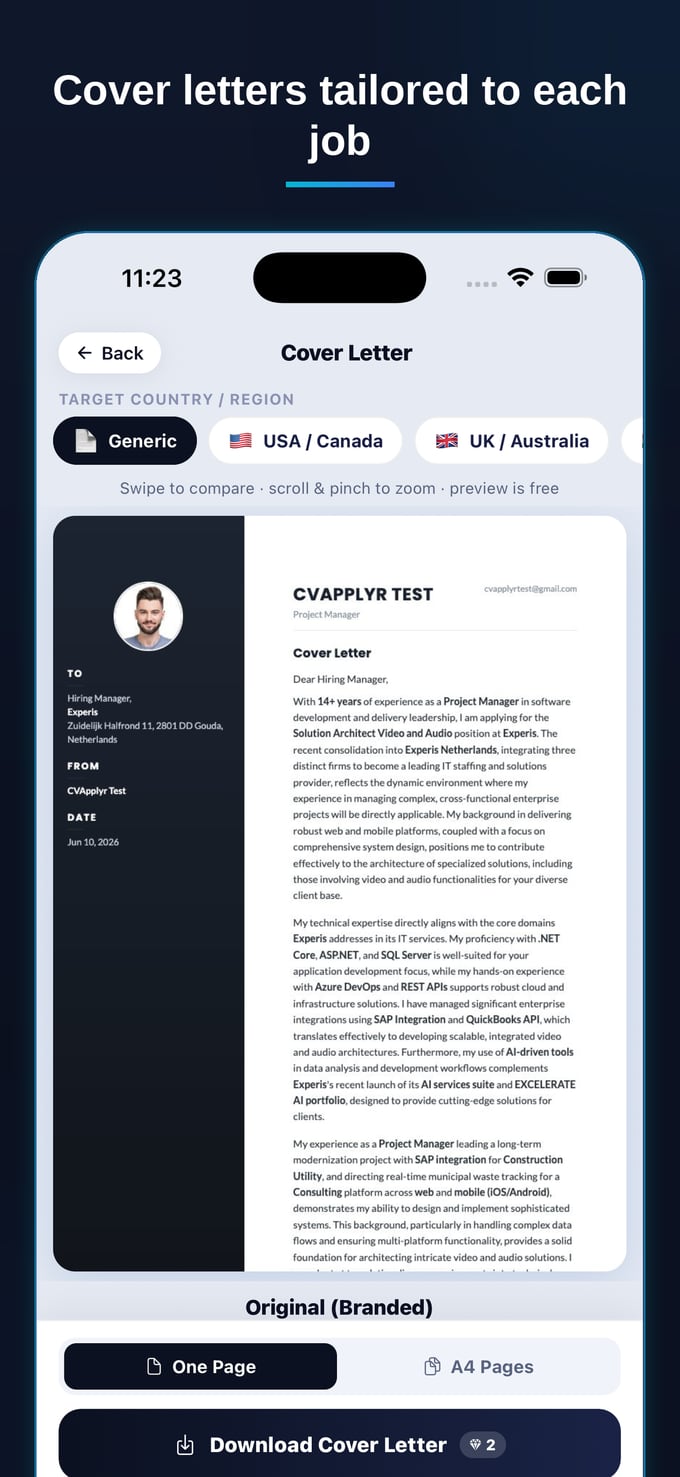
Then, for each role you apply to, it writes the cover letter against that job description: the break framed in one confident line, positioned in the second half, and the rest of the space spent on why your experience fits this specific opening. Not a template you find-and-replace forty times — a fresh, specific letter each time, in seconds. And where CVApplyr can surface a recruiter or hiring-manager contact for the role, you can send it to a person who will actually read the explanation, rather than into a screening queue that only sees dates.
The gap stops being the thing you rewrite at midnight before every single application, and goes back to being what it always was: a period of your life, briefly noted, on the way to the part about why you're right for the job.
Frequently asked questions
Do employment gaps really hurt your chances?
An explained gap rarely hurts. An unexplained one does — because a recruiter skimming for six seconds fills the silence with a guess, and the guess is usually worse than the truth. One clear line naming the break and its dates removes the ambiguity that actually costs you interviews.
Should I put the gap on my resume or save it for the interview?
Both, at different lengths. A short factual line on the resume so nothing looks hidden; one or two sentences in the second half of the cover letter for context; the fuller story at interview, where you can read the room and take follow-ups.
How do I explain a gap I'd rather not detail — like illness or burnout?
You're not obliged to disclose health details to anyone. A neutral, honest label — "Personal leave" or "Career break" — with the dates is enough. Name it, keep it brief, then move the reader's attention to how you stayed current and why you're ready now.
Can CVApplyr help me write this?
Yes. CVApplyr builds your resume from your own story, break included, and writes a cover letter tailored to each role that frames the gap in one confident line and spends the rest of the space on your fit. Free to start.