How Long Does a Job Search Take?
Everyone tells you "three to six months". Nobody tells you what those months are actually made of — or which weeks you can take back.

It's week nine. You've sent what feels like a lot of applications, had two screening calls that went nowhere, and you're now doing the thing every job seeker does at week nine: opening a new tab and typing "how long does it take to find a job". The answer you get back is always some version of three to six months, which is simultaneously true, unhelpful, and slightly terrifying — because it doesn't tell you whether your search is on track or quietly stalled.
Here's a better frame. A job search doesn't take a length of time. It takes a number of live conversations, and conversations arrive on a delay. Once you see the search that way, the calendar stops being a mystery — and it becomes obvious which weeks are structural, which weeks are yours, and where almost everyone loses a month without noticing.
Why "three to six months" is a useless answer
The range is an average across wildly different situations. A senior backend engineer in a hiring market, a career changer moving into a new field, and a new graduate competing for entry-level roles are not running the same race, and no single figure describes all three. Averages also hide the shape of the thing: most searches aren't a slow, even grind that resolves at the mean. They're long flat stretches of nothing, then three processes running at once, then an offer.
That shape matters, because the flat stretch is where people conclude they're failing and start making bad decisions — rewriting the resume for the fifth time, dropping their target salary, applying to roles they don't want. Usually nothing is wrong. The pipeline just hasn't filled yet.
The four clocks running at once
Every search runs four clocks in parallel. Only one of them belongs to you.
1. The arrival clock. How fast suitable roles get posted in your niche. In a broad field this is daily; in a narrow specialism it might genuinely be a handful of real openings a month. You don't control this, but you do control how much of it you actually see — most people are looking at one job board and missing the roles posted only on company career pages.
2. The response clock. How long an employer takes to look at what you sent, and whether they respond at all. Glassdoor's often-cited figure is that the average corporate opening attracts around 250 applicants, and a majority of mid- and large-size employers screen with an applicant tracking system before a human sees anything. Two to four weeks of silence is normal. Silence forever is also normal.
3. The process clock. Once someone says yes, a screening call, one or two interview rounds, a panel or take-home, internal debriefs, approval, then an offer. Every one of those steps waits on several busy calendars. Four to eight weeks from first call to signed offer is an ordinary, healthy process — not a bad sign.
4. The effort clock. How many good applications you actually put out per week. This is the only clock you can wind forward, and it's the one almost everyone under-runs, because doing it properly by hand is exhausting.
Read that left to right and the uncomfortable conclusion is unavoidable. If you apply to one role today and it works out perfectly, you're still eight to twelve weeks from an offer. Not because you did anything wrong — that's just what the machinery takes.
The compounding cost of a slow start
Because every application takes weeks to mature, applications are less like lottery tickets and more like seeds. Five sent in week one are worth far more than five sent in week six, and the difference compounds across the whole search.
Consider two people doing the arithmetic differently. Both have the same resume and the same response rate. One manages five applications a week — a realistic figure when each one means hunting the role down, rereading the description, rewriting a cover letter and fighting a portal form. The other manages twenty-five, because the mechanical parts are automated and their effort goes into choosing the right roles.
Neither person is more talented. One simply started five times as many clocks. By week eight, that's the difference between a search that feels dead and one with three processes running.
The obvious objection — doesn't volume mean worse applications? — is the right question, and it's why raw spam doesn't work. Untargeted applications don't just fail, they fail expensively: they eat the hours you needed for the roles you'd actually get. What shortens a search is volume with relevance, which historically was a contradiction. That's the constraint that's changed.
Where the weeks quietly leak away
Four leaks account for most lost time, and all four are fixable.
Searching one channel. If you only look at a single job board, your arrival clock is running at a fraction of its real speed. Plenty of roles are posted on a company's own careers page and never syndicated anywhere, or appear there days earlier — which matters when 250 people are queueing behind you.
Perfectionism on the first pass. Spending ninety minutes on one application does not beat spending ninety minutes on six, because the first filter is often automated and looks for relevance, not artistry. Save the deep work for the interview stage, where a human is actually reading closely.
Applying into the void. An application submitted through a portal joins a queue. The same application, plus a short note to a named recruiter or hiring manager, is a conversation. Studies consistently suggest referred and directly-introduced candidates convert at much higher rates — and reaching a person is often what turns three weeks of silence into a reply this week.
Losing the thread. Somewhere around application forty, people stop knowing who they've contacted, what stage each role is at, or which follow-up is due. Opportunities die of neglect at that point — not rejection.
You can't make an employer decide faster. You can make sure that by the time they do, four other conversations are already in flight.
Start more clocks, this week
Find live roles, get a tailored cover letter for each one in seconds, and reach a real contact where we can find one. Free to start.
Download CVApplyrHow CVApplyr compresses the calendar
None of the four employer-side clocks can be argued with. CVApplyr is built around the one clock you own — and around removing the friction that keeps a realistic weekly target at five applications instead of twenty-five.
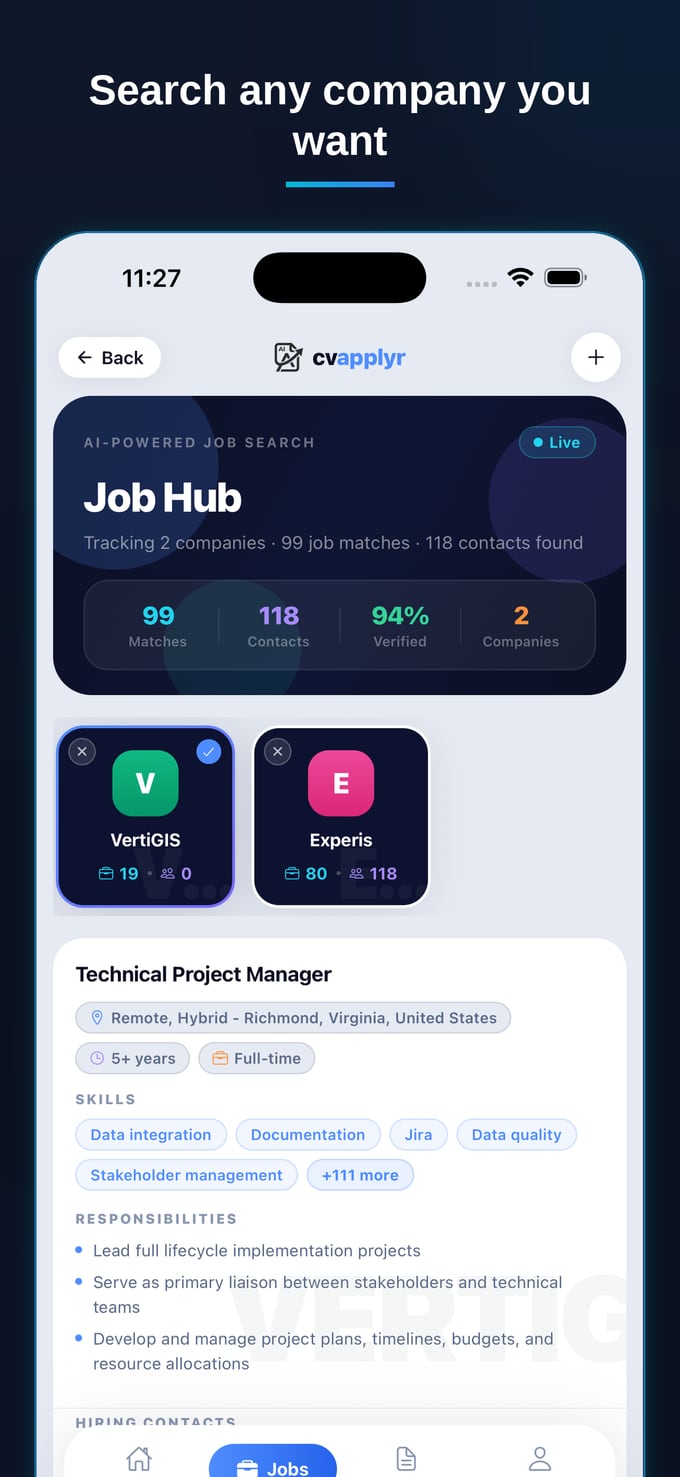
It pulls live openings straight from company career pages and applicant-tracking systems, not just the big boards, so the roles reach you when they're posted rather than when they're syndicated. Each one is matched against your resume, so the list you work through is ordered by fit instead of recency — the difference between volume and spray.
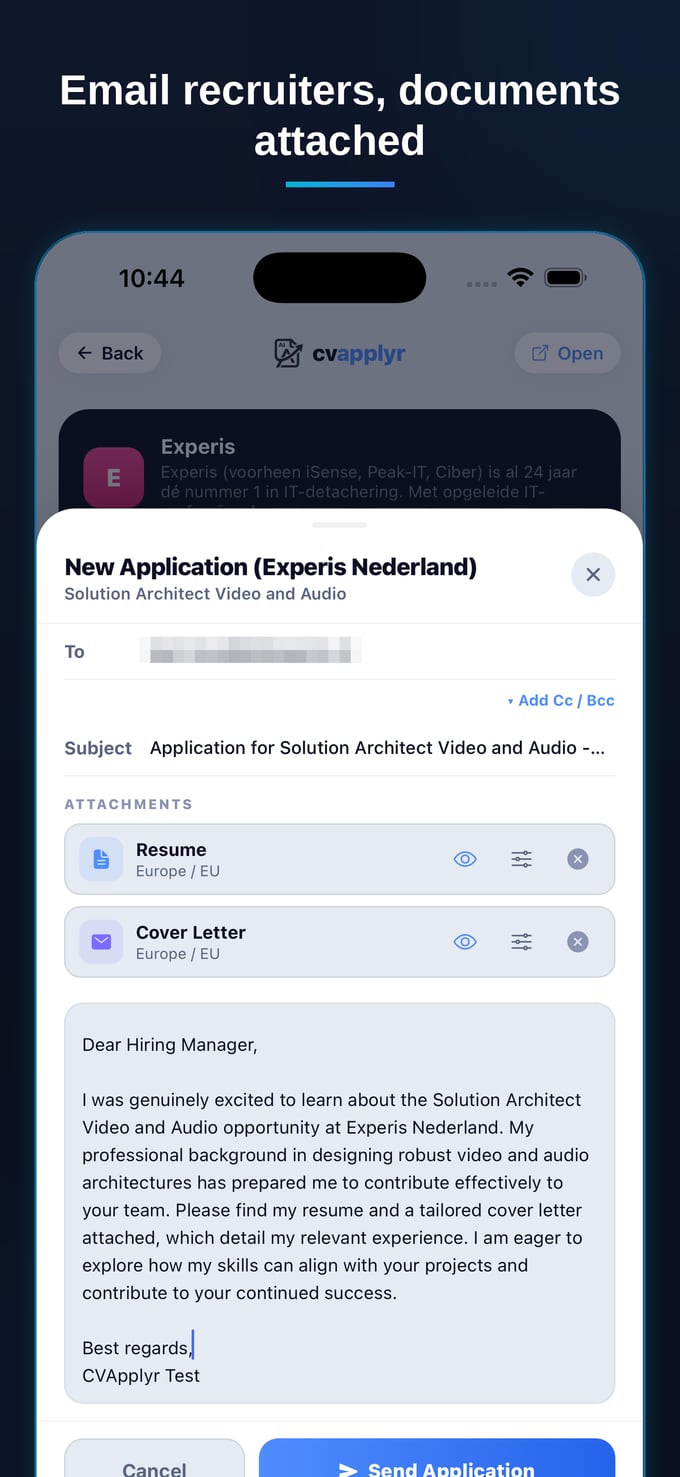
For every role you choose, it writes a cover letter against that job description in seconds, and builds your resume in the format employers in that country expect. Where a hiring contact can be found, you get a name and an email, plus a drafted note with your resume and letter attached — so applications land in an inbox rather than a queue. And everything you've sent stays in one place, with status and follow-ups, so nothing dies from being forgotten in week seven.
The realistic promise isn't that you'll get hired next Tuesday. It's that an evening's work now does what a fortnight used to, so by the time the employer-side clocks finish running, there are several of them finishing at once. That's how a search that would have ended in month five ends in month three — not by hurrying anybody, but by starting earlier and starting more.
If you're at week nine right now: nothing is wrong with you. Your pipeline is just thinner than the maths requires. Widen it this week, and week thirteen will look completely different.
Frequently asked questions
How long does it take to find a job on average?
There's no honest single average — it swings hard with field, seniority, location and how much you actually send. A more useful model: your search length is set by how many live conversations you can accumulate, and each one takes weeks of employer-side process. The lever is starting more of them, earlier.
Why does hiring take so long even after they like me?
The delays are structural, not personal. Screening call, interview rounds, a panel or task, internal debriefs, approval, offer — each waiting on several busy calendars. Multi-week gaps between stages are ordinary and usually say nothing about your chances.
Does applying to more jobs actually make the search shorter?
Yes, until quality drops. Response rates are low and mostly outside your control, so the conversations you have this week were decided by the applications you sent a month ago. Volume with tailoring shortens a search; untargeted volume mostly generates rejections and eats the hours you needed for the good roles.
How can CVApplyr shorten my job search?
It attacks the part you control: live roles pulled from company career pages, matched to your resume, a tailored cover letter per role in seconds, and a real hiring contact where one can be found — so the same weekly effort produces many more applications, sent sooner. Free to start.