The Follow-Up Email That Actually Gets Responses
Most applications die in silence — not because you weren't a fit, but because nobody followed up. A short, well-timed note changes that. Here's exactly what to send, and when.

You hit submit, you felt good for about ten minutes, and then… nothing. A week goes by. Two. You start to wonder whether the application even arrived, or whether it's sitting in a queue behind 200 others, slowly going cold. The hard truth is that for most roles, the silence isn't rejection — it's just that nobody got around to you yet. And the single most reliable way to get got around to is a follow-up email.
Almost nobody sends one. That's exactly why it works. A short, specific, well-timed note pulls your name back to the top of the pile, signals that you actually care about this job, and — crucially — gives a busy recruiter a reason to act now instead of later. Let's break down the timing, the wording, and how to make following up so easy you'll actually do it.
Why the follow-up matters more than you think
Picture the other side of the inbox. A recruiter is juggling a dozen open roles, each pulling in dozens or hundreds of applicants. The average corporate opening attracts around 250 applications, and only a handful ever get a real look. Your application isn't being rejected — it's being missed. A follow-up is a polite tap on the shoulder that says: I'm still here, I'm still interested, and I'm easy to move forward.
It also does something subtler. It demonstrates the exact qualities employers say they want — initiative, communication, follow-through — before you've even reached an interview. You're not just claiming you're proactive; you're proving it in their inbox.
Notice what the chart does not claim: a guaranteed number. Reply rates swing wildly by field, seniority, and how busy the team is. But the direction is consistent across nearly every hiring study and recruiter survey — sending one thoughtful follow-up reliably beats sending nothing.
When to send it — the timing that works
Timing is where most people get it wrong in both directions. Send too soon and you look anxious; wait too long and the role's already filled. Here's the rhythm that lands in the sweet spot.
After applying: wait about a week
Give the team five to seven business days to review applications before you nudge. That's long enough that you're not interrupting their first pass, but soon enough that the req is still open and your name still means something. Anything earlier reads as impatient; much later and the shortlist may already exist.
After an interview: thank-you within 24 hours, then a week
If you've actually spoken to someone, send a thank-you note the same day or the next morning — short, specific, referencing something you discussed. Then, if a week passes after the date they said they'd decide and you've heard nothing, a gentle "still very interested, any update on timeline?" is completely fair.
What to actually write
A follow-up email should be embarrassingly short. Recruiters skim — most spend only a few seconds per message — so every extra paragraph lowers the odds it gets read. The whole thing has four moving parts:
1. A subject line that locates you instantly. Something like "Following up — [Your Name], [Role] application". No mystery, no clickbait. Make it trivially easy for them to know who you are and what this is about.
2. A one-line reminder. State the role and roughly when you applied. They have a hundred threads open; do the remembering for them.
3. One specific reason you're a strong fit. Not your whole résumé — one concrete, relevant detail. "I led the migration you mentioned in the JD at my last role" beats "I'm a hard worker and fast learner" every time.
4. A low-pressure ask. A question about timeline or next steps gives them something easy to reply to. "Is there a timeline for next steps?" invites a one-line answer, which is exactly what a busy person can manage.
The best follow-up doesn't sound like you're chasing. It sounds like a capable colleague checking in — specific, brief, and easy to say yes to.
Put together, a clean follow-up looks like this:
Hi Daniel,
I applied for the Senior Analyst role last Tuesday and wanted to reaffirm how interested I am. I noticed the team is rebuilding its reporting stack — I led a similar migration to dbt at Acme that cut our reporting time in half, so I'd love to bring that experience here.
Is there a timeline for next steps? Happy to share anything that would help.
Best,
Priya
Four sentences. Specific. Easy to answer. That's the whole game — and it works far more often than a long, anxious essay ever will.
The real reason people don't follow up
It's almost never that they don't know they should. It's that following up well is annoyingly fiddly. To send that clean little note, you have to remember which roles you applied to, dig up when you applied, find a real human's email instead of a no-reply address, and reconstruct enough context to sound specific rather than generic. By application number twenty, your "system" is a half-dead spreadsheet and a sent folder you can't bear to scroll through. So the follow-up — the highest-leverage thing you could do — quietly never happens.
This is the part where the right tool earns its keep. The writing isn't the bottleneck; the bookkeeping is.
CVApplyr keeps every application ready to follow up
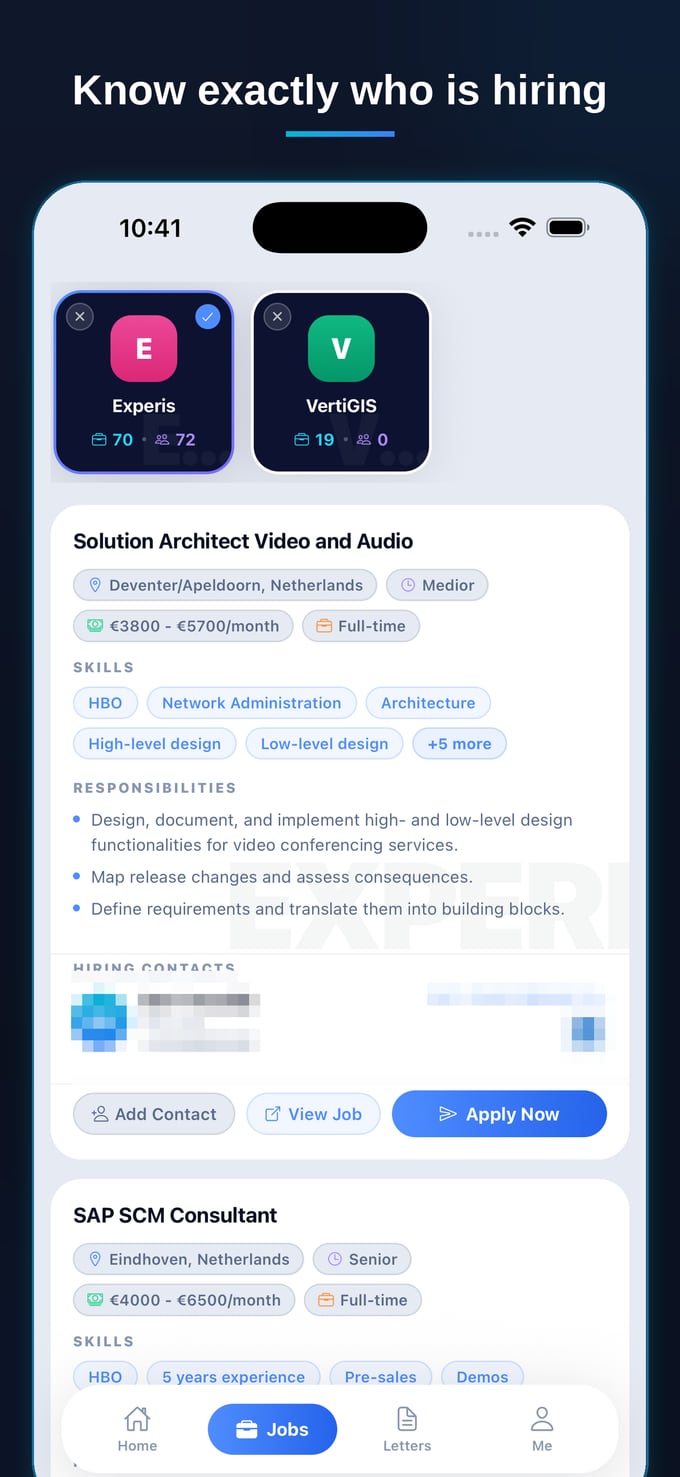
CVApplyr saves each role you act on as a live record — the company, the position, the date you applied, the recruiter or hiring-manager contact, and the current status, all in one place. So when it's time to nudge, you're not excavating your memory or your inbox. You open the app, see exactly who hasn't replied and when you applied, and follow up in a tap.
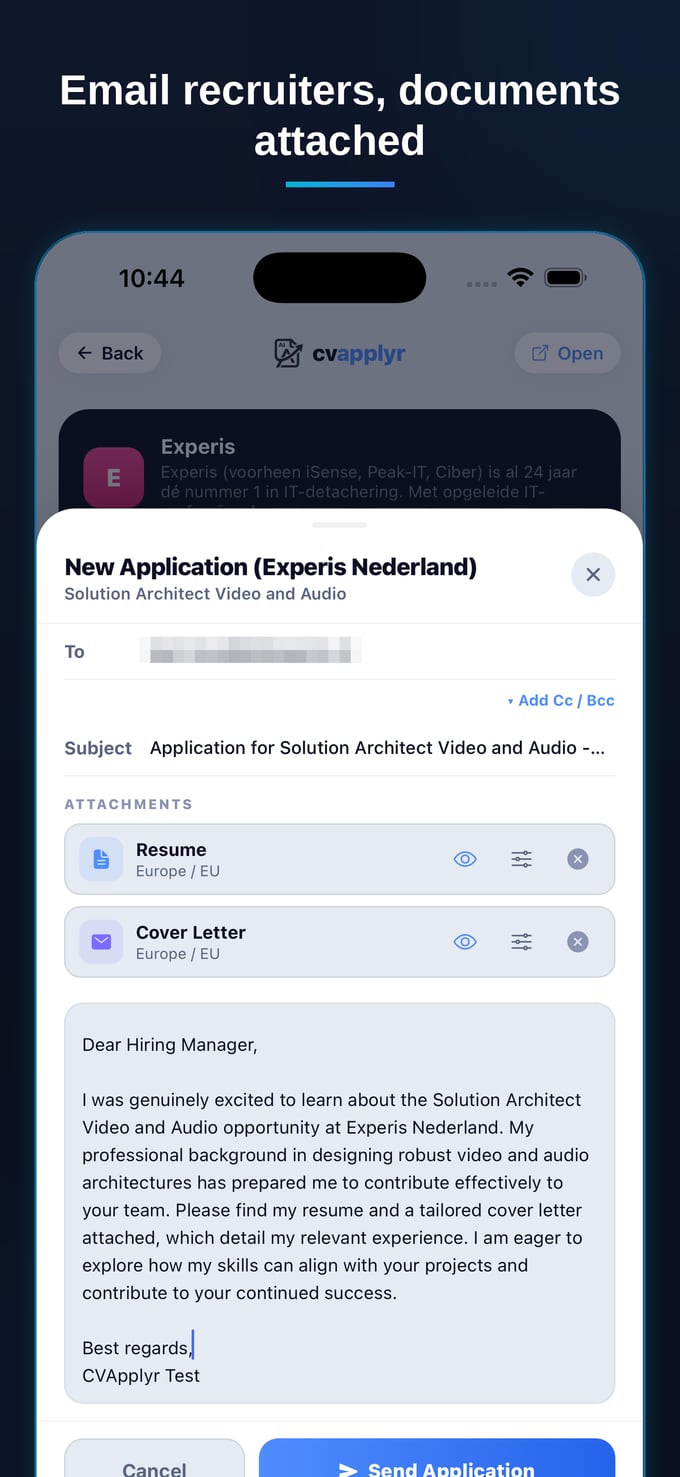
Because the contact is attached to the application, you're emailing a real person rather than firing into a portal black hole. And CVApplyr can draft the message for you — pulling in the role and your background so it reads specific, with your résumé and cover letter already attached. You skim it, adjust a line if you want, and send. The friction that normally kills the follow-up just isn't there.
Putting it all together
Following up isn't about being pushy or clever. It's about being one of the few candidates who simply shows up again — at the right moment, to the right person, with a sentence that proves you read the job. Apply, wait a week, send a short specific note, and if you still hear nothing, send one more a week later. Then keep your energy moving toward the next roles.
Do that consistently across every application and you stop leaving replies on the table. The hard part was never the email — it was remembering to send it and having the context ready. Hand that bookkeeping to a tool, and the follow-up finally becomes a habit instead of a good intention.
Never let an application go cold
Keep every role, contact, and status in one place — and follow up in a tap. Free to start.
Download CVApplyrFrequently asked questions
How long should I wait before following up on a job application?
A good default is five to seven business days after you apply — roughly a week. That's long enough for your application to be reviewed but soon enough that the role is still fresh. If you interviewed, follow up within 24 hours with a thank-you, then again about a week after that if you haven't heard back.
What should a follow-up email say?
Keep it short: a one-line reminder of which role you applied for, a sentence on why you're a strong fit, and a low-pressure ask about timeline or next steps. Reference something specific about the role or team so it reads as personal, not copy-pasted. Three to five sentences is plenty.
How many times should I follow up?
Usually one or two follow-ups is the right amount. Send the first about a week after applying, and a second a week or so after that if you still hear nothing. Beyond two, you risk being a nuisance — at that point it's better to move your energy to other roles while keeping the door open.
How does CVApplyr help me follow up?
CVApplyr keeps every application, the recruiter or hiring-manager contact, and the current status in one place, so you can see exactly who to email and when. It also surfaces the right contact and can draft a tailored message with your resume and cover letter attached — so following up is a tap, not a research project.