New-Grad Job Search: Stand Out With No Experience
Every entry-level posting seems to want "2+ years of experience." You're applying for your first real job — so where is that supposed to come from? Here's how to compete on what you actually have.

You did everything they told you to. You got the degree, maybe a certificate or two, you built things in class and on your own — and now every job that's supposedly "entry-level" asks for experience you can't have yet because nobody will give you the first one. It's the most demoralising loop in the early career: you need a job to get experience, and you need experience to get a job. If you've been quietly wondering whether you're just not good enough, stop. You're stuck in a chicken-and-egg problem, not a competence problem — and it has a way out.
The good news is that "no experience" is almost never literally true. You have coursework, projects, internships, volunteer roles, part-time jobs, and a pile of transferable skills you haven't learned to name yet. The work isn't to invent experience — it's to translate what you've already done into the language a hiring manager reads. Let's break down why this feels so hard, and the exact system that turns your story into applications that get read.
Why "no experience" feels like a wall
Three things are happening at once when you're a new grad, and together they feel like a locked door:
The job descriptions lie a little. That "2+ years required" line is usually a wishlist, not a hard gate. Plenty of teams hire juniors who hit most of the list and show they can learn fast. But you can't tell which postings are flexible from the outside, so the safe move is to apply to more of them — not fewer.
You can't see your own value. When you built a capstone project, ran a student club's budget, or kept a part-time job through finals, you experienced it as "just stuff I did." A recruiter would read those as project delivery, budget ownership, and reliability under pressure. The raw material is there; the framing isn't.
Entry-level is crowded. A single junior opening can pull hundreds of applicants, so a generic resume disappears instantly. You need both relevance and volume — and doing both by hand is exhausting, which is exactly where most new grads stall out.
What you actually compete on (it isn't years)
Here's the reframe that changes the whole search. Experienced candidates compete on years. You can't win that game, so don't play it. You compete on a different axis entirely — what you've built, the skills you can prove, and how precisely each application fits the role.
Look at that grey bar at the bottom. That's the thing you can't change, and it's also the thing you keep fixating on. Every minute you spend feeling behind on years is a minute not spent strengthening the bars you can actually grow. So let's grow them.
The system: turn your story into applications
Here's the part nobody teaches in school: the search is a workflow, not a personality test. You take what you've done, shape it into a resume that speaks the employer's language, and send it — tailored — to enough matched roles to beat the odds. Here's that workflow step by step, and how CVApplyr handles the heavy lifting.
1. Start with your story, not a blank template
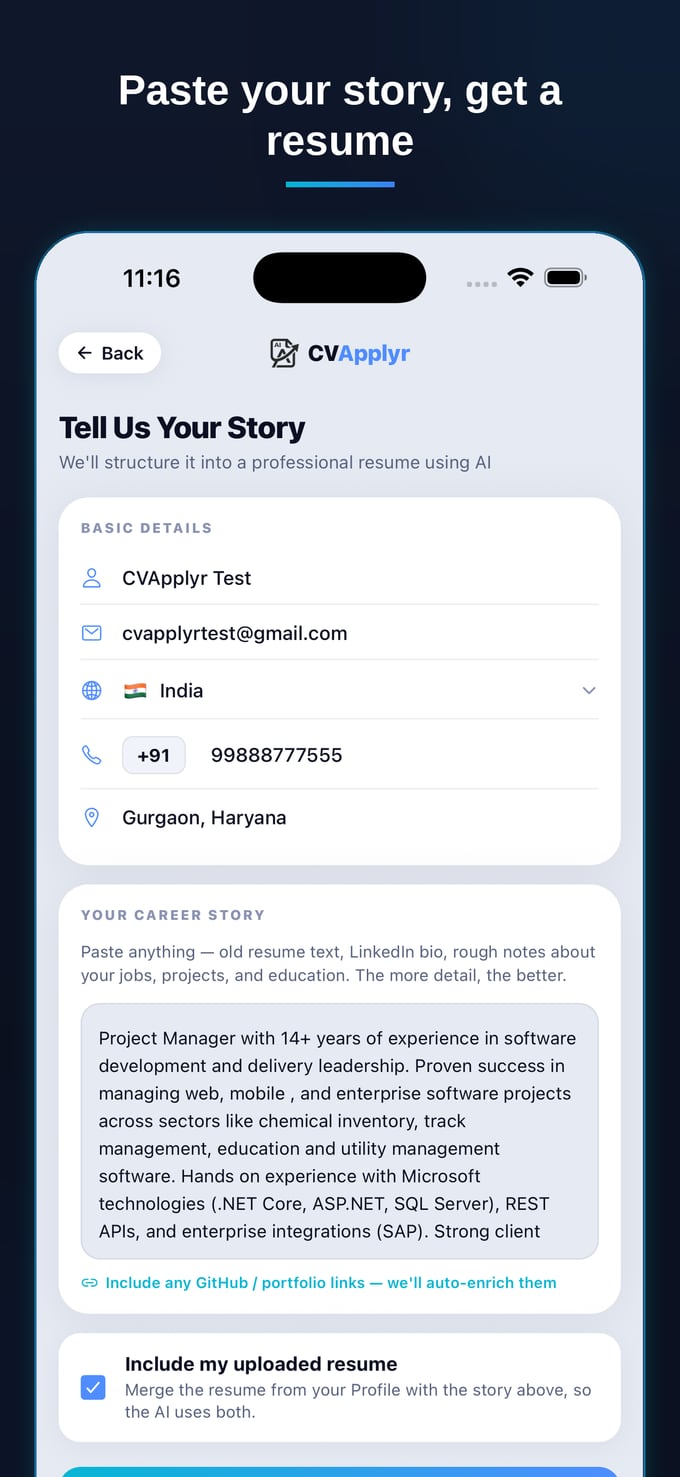
The hardest part of a first resume is the blank page. You stare at "Work Experience" with nothing to put under it and freeze. CVApplyr flips that: instead of formatting a document, you just tell it your story — the projects you built, what you studied, the tools you know, the part-time job that taught you to show up. It reads that and shapes it into a real resume structure: a tight summary, a projects section that leads, education, skills, and any internships or volunteering, all in a country-correct format. The thing you didn't know how to start now starts itself.
2. Make projects do the work experience can't
For a new grad, projects are your experience. A class project, a hackathon build, a freelance gig, a personal site — each one is proof you can take something from idea to finished. The trick is writing them like a professional would: what you built, the tools you used, and the outcome. "Built a budgeting app in React used by 30 classmates" beats "did a coding project" every time, and CVApplyr helps phrase each one in that result-first way so a recruiter skimming for six seconds actually stops.
3. Name your transferable skills out loud
You think you have no experience because you're discounting everything that wasn't a "real job." But the barista shift that taught you to stay calm with a queue out the door? That's customer handling and grace under pressure. The group project where you herded five people to a deadline? Coordination and ownership. These translate directly, and a good resume names them explicitly so they're not left for the reader to guess.
4. Tailor every application — without spending an hour each
This is where most new grads lose. They write one resume, blast it at 50 jobs, and wonder why nothing lands. A junior posting for a data analyst and one for a marketing coordinator should pull different projects and skills to the top — and that tailoring is exactly what makes a thin resume look like a strong fit. CVApplyr reads each job description and reshapes your resume and cover letter to match that role, so you stay tailored at volume instead of choosing between the two.
Read those numbers together and the strategy writes itself. With ~250 people chasing one role, a six-second skim deciding your fate, and a robot filtering first, a generic resume is invisible. A tailored one that leads with relevant projects and the right keywords is how a no-experience candidate gets seen at all.
You don't need a decade of experience to get hired. You need one resume that tells your story well — and the patience to send it, tailored, to enough of the right doors.
Then apply where the odds are better
A perfect resume still loses if it lands in a black hole. Two things tilt the odds in your favour as a new grad. First, apply directly on real company careers pages rather than only the giant boards everyone floods — CVApplyr surfaces entry-level roles matched to your profile from those pages, so you're applying to openings that fit instead of doom-scrolling. Second, reach a human where you can: CVApplyr surfaces a recruiter or hiring-manager contact for a role where available, so a junior application becomes a short, polite note to a real person instead of a form submission you'll never hear about.
And because the whole thing is tracked, you're not running your first big job hunt out of a panic and a half-finished spreadsheet. Every role you act on is saved with its status and contacts, so following up — the step most new grads skip — is a tap, not a memory test.
What this looks like over a week
Put it together and your search stops feeling like shouting into a void. Monday night you paste your story once and CVApplyr builds your base resume. The rest of the week you open a short list of matched entry-level roles, accept the tailored letters that look right, send them to real contacts where you can, and log each one — in the time it used to take you to force out a single generic application. Same effort, far more shots on goal, and a resume that gets stronger every time you refine it.
Turn your story into a resume that gets read
Paste your projects and coursework, get a tailored resume and cover letter, and apply to matched entry-level roles — free to start.
Download CVApplyrFrequently asked questions
How do I get a job with no experience?
You compete on what you do have: coursework, class and side projects, internships, volunteer work, part-time jobs, and transferable skills. Translate each into outcomes a hiring manager cares about, then apply to entry-level and "junior" roles in volume with a resume tailored to each posting. Most new grads who land offers send a lot of targeted applications, not a handful of generic ones.
What goes on a resume when you have no work history?
Lead with a short summary, then a Projects section (what you built, the tools you used, and the result), followed by Education, relevant coursework, skills, and any internships, volunteering, or part-time work. Quantify wherever you can. CVApplyr can take your projects and story and shape them into this structure automatically, in a country-correct format.
How many jobs should a new grad apply to?
Entry-level roles are crowded, so volume matters — many successful new grads send dozens of tailored applications a week, not three or four. The trick is keeping each one targeted without spending an hour per role. Automating the tailoring lets you stay both high-volume and relevant.
How does CVApplyr help new grads?
You paste your story — projects, coursework, and skills — and CVApplyr turns it into a polished, tailored resume and cover letter for each role. It also finds entry-level jobs matched to your profile from real company careers pages, surfaces recruiter and hiring-manager contacts where available, and tracks every application. It's free to start.