Recruiter vs. Hiring Manager: Who to Actually Email
They want different things, read your message differently, and make different decisions. Send the same email to both and you'll underwhelm both. Here's how to tell them apart — and what to say to each.

You found a role you genuinely want, and you're ready to reach out instead of dropping into the void with everyone else. Then you freeze on the most basic question: who do I even email? The recruiter whose name is on the post? The manager who'll actually run the team? Somebody on LinkedIn with a vaguely related title? Pick wrong, or write one message that tries to please both, and your perfectly good note lands flat — too logistical for the manager, too in-the-weeds for the recruiter.
It's a small decision that quietly decides whether your outreach works. Recruiters and hiring managers sit on completely different sides of the same hire, and once you understand what each one is actually trying to do, the right move — and the right words — gets obvious. Let's break it down.
They're not the same job — not even close
The recruiter and the hiring manager are both "people who can get you hired," but that's where the overlap ends. They have different incentives, different inboxes, and different ideas of what makes you interesting.
The recruiter is the gate
A recruiter — whether in-house talent acquisition or an external agency — owns the process. They source candidates, run the first screen, manage the pipeline, schedule interviews, and keep everyone moving. They're often juggling a dozen open reqs at once, so their default question about any candidate is simple: does this person clear the bar and is this going to be easy? Do you meet the must-haves, are you available, are your expectations realistic, will you respond and show up. A recruiter can't usually decide to hire you, but they can absolutely decide to move you forward — or not.
The hiring manager is the buyer
The hiring manager is the person who'll actually manage you and who has a problem they need solved. They opened the role because something on their plate is bigger than their current team can handle. They don't care about your availability yet — they care whether you can do the work. Have you solved something like their problem before? Will the team ship faster with you on it? They have the authority to say "I want to talk to this person," and when they say it, recruiters move fast.
What each one actually cares about
Here's the side-by-side that makes the whole thing click. Same role, two readers, two completely different sets of priorities — and two different messages.
Read those two columns back to back and the mistake most people make jumps out: they write one email — usually a polite, logistical "I applied, please consider me" — and send it to whoever they can find. To a recruiter that's fine but forgettable. To a hiring manager it's noise, because it says nothing about the work. Match the message to the reader and the same effort lands twice as hard.
So who do you email first?
Here's the practical sequence that works for most roles.
1. If the role is process-heavy, start with the recruiter
Big company, structured hiring, a named recruiter on the post? Go to them first. A short, specific note — "I applied for the Senior X role, I've done A and B which map to your must-haves, and I'm available to talk this week" — makes their job easier and gets you flagged as a serious, low-friction candidate. You're not bypassing the process; you're greasing it.
2. If you have a real hook, go straight to the manager
Smaller team, or you genuinely understand the problem they're hiring to solve? A direct, two-line note to the hiring manager can leapfrog the queue entirely. The key word is hook: you reference the specific thing they're building, point to the time you did exactly that, and offer the result. No hook, no direct email — you'll just look like another mass-blast.
3. When you can, do both — in the right order
The strongest play is rarely either/or. Reach the recruiter so the gate opens, and reach the manager so there's pull from the inside. A hiring manager forwarding your name to the recruiter with "talk to this person" is the single fastest way through a hiring process. The only thing standing between you and that move is usually one piece of information: who, exactly, is each of those people?
Most outreach fails not because the message is bad, but because it's pointed at the wrong person. Get who-to-email right and a mediocre note beats a brilliant one sent into the void.
The hard part isn't the message — it's finding the person
Notice that every tactic above assumes you already know who the recruiter and the hiring manager are. That's the step that quietly kills most people's good intentions. The job post rarely names them. LinkedIn gives you fifteen plausible candidates and no certainty. Email-pattern guessing works until it doesn't. So you either burn twenty minutes per role playing detective, or you give up and submit into the applicant-tracking system like everyone else.
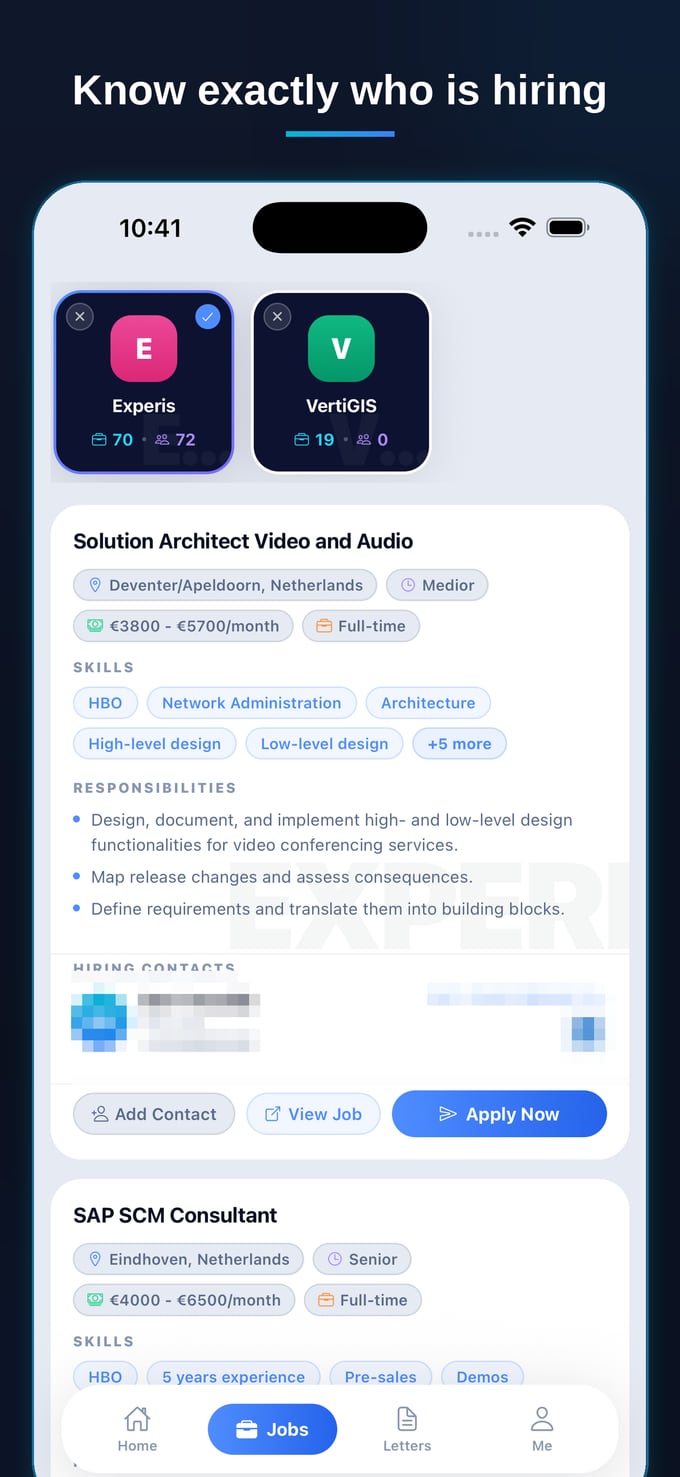
This is exactly the gap CVApplyr closes. For a given role, it surfaces the relevant hiring contact right next to the listing — so instead of starting your outreach with "who do I even email?", you start it already knowing. You can see who owns the decision, then write the message that fits that person: a fit-and-availability note to a recruiter, a problem-and-proof note to a hiring manager.
From "who?" to "here's exactly who" — in the app
The screenshot up top shows it in practice: a real role with its hiring contacts attached, plus the ability to add a contact, view the full job, or apply directly. You're not guessing at a name and praying the email pattern is right — you're looking at the person tied to the role before you've written a single line. That one change turns outreach from a research project into a thirty-second decision.
When ~250 people are dropping the same generic application into the same form, the candidate who emails the right person with the right message stands out almost by default. Not because they tried harder — because they aimed better.
Email the right person, every time
See the relevant recruiter or hiring-manager contact for a role, then send a message built for them — free to start.
Download CVApplyrA quick script for each
To make this concrete, here's the shape of each message. Keep both short — three or four sentences is plenty.
To a recruiter: open with the role, state the two or three must-haves you clearly meet, confirm you're available and interested, and offer a time to talk. You're making it effortless for them to advance you.
To a hiring manager: open with the specific problem or project you know they're working on, name the time you did exactly that and the result you got, and offer to share more. You're making it obvious the team would be better with you on it.
Same role, same you — but two messages that each land because they're written for the person reading them.
Frequently asked questions
Should I contact the recruiter or the hiring manager?
It depends on the stage. Early on, the recruiter owns the process — they screen, schedule, and pass strong candidates along, so a clear note to them moves things fastest. If you can also reach the hiring manager with a short, specific message about the work, do both: the recruiter clears the gate, the manager creates the pull. When you're not sure who's who, message whoever you can identify with confidence.
What do recruiters care about vs hiring managers?
Recruiters care about fit and logistics: do you meet the must-haves, are you available, what are your expectations, and will you stay engaged through the process. Hiring managers care about the actual work: can you solve the problem on their plate, have you done something similar, and will the team be better with you on it. Speak to must-haves and availability with a recruiter; speak to impact and a concrete example with a manager.
Is it rude to email the hiring manager directly?
No — not if you keep it short, specific, and respectful of their time. A two-line note that shows you understand their team's problem reads as initiative, not overstepping. It becomes rude when it's a generic copy-paste, ignores the recruiter entirely on a process-heavy role, or pushes for a decision they can't make alone. Lead with relevance, make it easy to say yes, and you'll rarely get a bad reaction.
How does CVApplyr show me the right contact?
For a given role, CVApplyr surfaces the relevant hiring contact — a recruiter or hiring-manager-level person tied to that company or team — right alongside the listing. You see who owns the decision before you write a word, so you can tailor the message to the person instead of firing it into an applicant-tracking black hole. It's free to start, so you can try contact discovery before you ever pay.